
Antepost Golf Betting Strategy: How Early Prices Create Systematic Value Before the Field Is Set
 Available in US
The first time I backed a Major winner antepost, I got lucky. The second time, I had a system. There is a meaningful difference between those two things, and it took me longer than I’d like to admit to understand it. Placing a bet six weeks before a tournament starts is not, on its own, a strategy—it’s a timeline. The strategy is knowing exactly which windows produce mispriced odds, why the market corrects itself at predictable moments, and how to manage the specific risk that comes with money tied up in futures markets. That’s what I want to lay out here.
Antepost golf betting—betting on tournament outright markets weeks or months before the event—sits in an odd space. Most recreational bettors treat it as a punt: back a big name early, hope the price doesn’t shorten too dramatically, and forget about it until the Thursday. Systematic bettors treat it differently. Early prices contain genuine inefficiencies, but they’re specific to certain windows, certain player types, and certain tournament structures. Get those details wrong and antepost becomes a way to lock in a bad price with added non-runner risk. Get them right and you’re backing at 28/1 what the market prices at 18/1 come Monday of tournament week.
When Antepost Prices Offer Genuine Value: The Timing Windows That Matter
I spent two seasons tracking the relationship between antepost prices and opening-week odds across the four Majors and a selection of Rolex Series events on the DP World Tour. The pattern that emerged isn’t complicated, but it takes discipline to exploit consistently. There are three windows where early prices reliably differ from market consensus—and only one of them is actually worth targeting for most systematic bettors.
The first window opens when a tournament’s betting market goes live, typically six to twelve weeks before the event. At this point, the prices are set by compilers working from recent form data with limited course-specific adjustment. Players who have shown strong strokes-gained numbers in recent events but haven’t yet attracted public attention are frequently underpriced. The bookmaker’s model prioritises recognisable names with strong recent finishing positions—finish positions that, as any SG-literate bettor knows, are a noisy proxy for actual quality. This is where I’ve found the most consistent value over nine years of tracking these markets.

The second window comes four to six weeks before the event, when course-specific betting analysis begins to appear in mainstream golf media. Prices tighten significantly here. A player who was 40/1 six weeks out might be 28/1 after a Racing Post feature or a prominent social media mention. If you’ve missed the opening window, this period is generally too late—you’re now paying for information that’s already in the market.
The third window is the week before the event itself, when the field is finalised and the draw is released. This can produce short-term movements on specific players—a player who draws a favourable tee time pairing, for instance, or someone whose world ranking has shifted the opening morning lines. But by this point, most of the antepost structural advantage has been arbitraged away. The pre-tournament week is where I typically do my last-minute adjustments within a bet365 each-way golf betting system, not where I’m looking for antepost value.

A concrete example from 2025 illustrates the timing dynamic clearly. Consider a ball-striking specialist who finished outside the top 25 in his three most recent starts but whose strokes-gained approach and off-the-tee numbers over the prior 24 rounds placed him in the top 8 of the field for an upcoming Major venue with tight fairways and soft rough. At six weeks out, that player was available at 35/1. By tournament week, after two solid preparation events, he had shortened to 18/1. The public price moved on visible finishing positions. The antepost price moved because the underlying signal was always there—it just took the broader market six weeks to see it.
The practical rule I use: commit antepost capital in the first two weeks after a Major market opens, targeting players between 25/1 and 70/1 whose recent SG:APP and SG:OTT data significantly outperforms their finishing position trend. Above 70/1, non-runner risk starts to erode the expected value of the antepost premium. Below 25/1, the market is usually efficiently priced within the opening fortnight.
Managing Non-Runner Risk in Antepost Golf Markets
Non-runner risk is the reason many otherwise sensible bettors avoid antepost golf entirely. I understand the instinct but think it’s an overcorrection. The risk is real—players withdraw due to injury, form concerns, or schedule changes—but it’s manageable if you build it into your staking framework rather than treating it as an unknowable hazard.

The first thing to understand is how different bookmakers handle non-runners in golf outrights. Most UK bookmakers apply a non-runner no-bet rule for antepost golf markets, meaning if your selection withdraws before the tournament begins, you receive your stake back. This protection significantly changes the risk calculus—you’re not losing your stake if a player pulls out, you’re simply losing the time value of that capital being tied up. The exception is certain Exchange markets and some in-play converted antepost positions, where the terms differ. Always confirm the non-runner terms before placing any early outright.

Even with stake protection, non-runner risk isn’t trivial. A player who withdraws from the field denies you the return on the price you backed—if your 30/1 selection pulls out, you recover your stake but you’ve foregone the opportunity to deploy that capital at tournament week prices elsewhere. Over a season, if you’re backing five to eight antepost positions per Major, this opportunity cost accumulates.
The way I manage this is through position sizing. Antepost stakes are set at 60-70% of what I’d stake on the same player at tournament week prices. The reduced stake accounts for the non-runner opportunity cost and the extended capital lock-up period. If a player at 30/1 antepost would warrant a 1-point each-way stake at tournament week under my standard staking rules, I’ll back them at 0.6-0.7 points each-way antepost. This isn’t arbitrary—it reflects the actual expected value adjustment for the risk profile difference.
High withdrawal-risk player profiles worth being cautious about: veterans with chronic injury histories, players managing minor niggles mentioned in post-round interview transcripts, and players with unusually congested schedules in the six weeks before the event. These signals are public—they appear in press conference transcripts and tour schedule databases—but most antepost punters aren’t reading them systematically. I maintain a simple note for each antepost position tracking any withdrawal signals that emerge after placing the bet.
Antepost Strategy for Golf Majors: Augusta to The Open
Majors deserve their own antepost framework because they attract a different level of bookmaker attention than regular tour events. The prices are set more carefully, adjusted more frequently, and the public interest in backing recognisable names creates more systematic distortions than you see on a standard Rolex Series event. The Steve Palmer approach—Racing Post’s long-running golf analyst posted 10.81% ROI across 1,376 stakes in 2025, including winners at 66/1 and 60/1—demonstrates that Major outright markets remain beatable at high prices, but the method matters as much as the result.

Augusta National is the Major where course history carries the most weight in my antepost model, and the DataGolf analysis supports this. The course demands creative ball-striking and a specific approach game profile—strokes-gained approach data from the prior two Augusta appearances correlates more strongly with finishing position there than at any other Major. Players who have contended at Augusta without winning often represent the best antepost value, because the public prices them based on a lack of a green jacket rather than their actual Augusta-specific performance profile.
The Open Championship presents a different antepost calculus. Links-adapted players—those with strong wind-game SG numbers and low trajectory iron approaches—are frequently underpriced in early markets because the compiler field models draw heavily on all-surface form. I target players with strong DP World Tour links records who haven’t yet appeared in the mainstream “top ten tips” lists that dominate early Open betting coverage. Once a player appears in three or more major publication preview lists, the antepost premium has usually been arbitraged away.
The US Open and PGA Championship both reward specific player archetypes—accurate long drivers for the US Open’s typical rough-and-narrow setup, and elite ball-strikers for the PGA’s modern venue rotation. For both, the antepost window is tighter: markets open later and adjust faster because field interest is concentrated and the bettor base is more engaged than at DP World Tour events. I typically limit antepost activity on US Open and PGA Championship markets to the opening five days after field speculation becomes concrete, usually eight to ten weeks before the event.
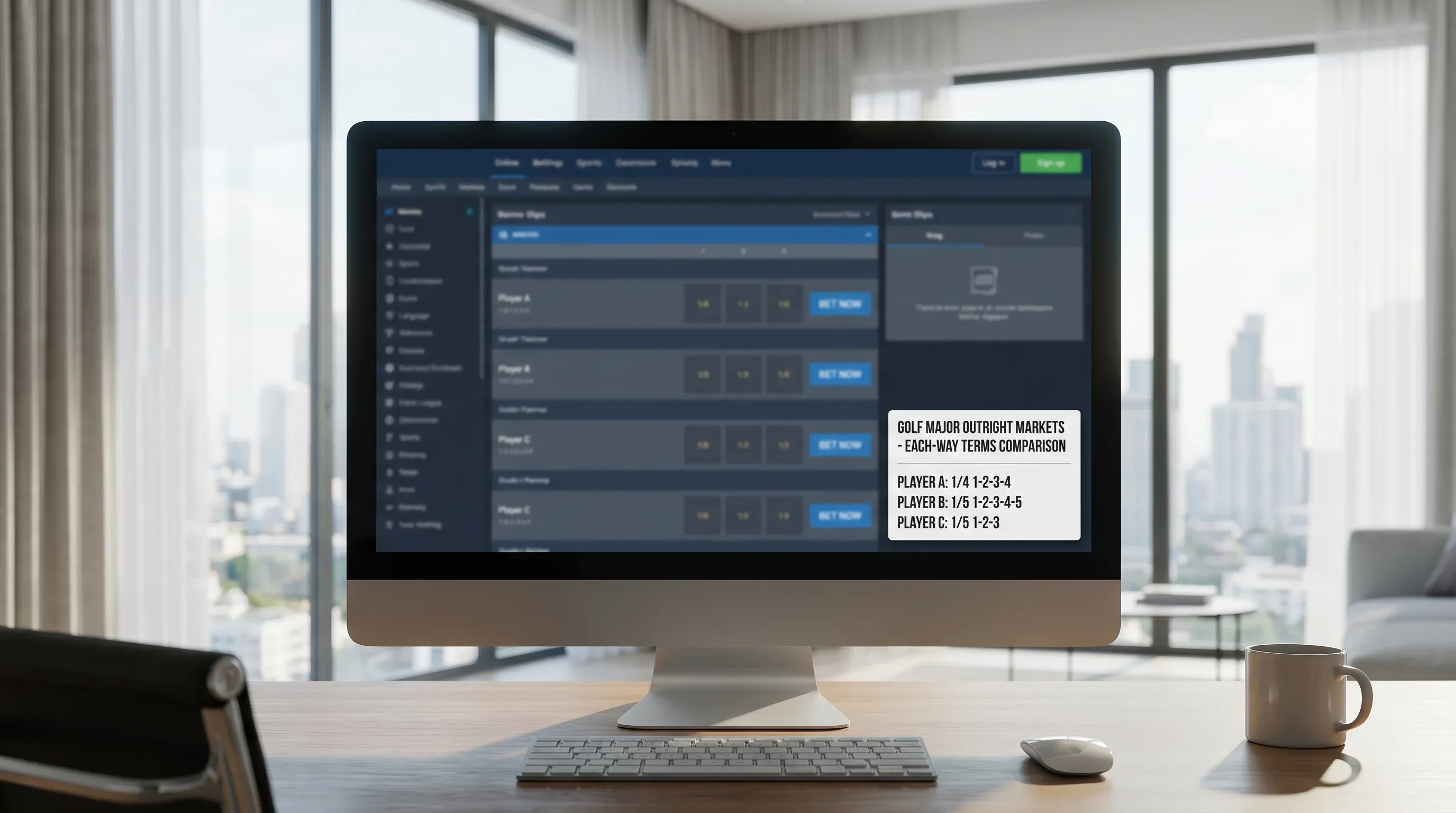
One practical note on each-way terms for antepost Major markets: most UK bookmakers offer standard terms (1/5 the odds, 5 places) on antepost outright Majors, not the enhanced terms you can access at tournament week through features like Each Way Extra. This is a genuine reduction in expected value versus waiting for tournament week. The antepost price premium needs to more than compensate for this terms reduction—and it often does, but you need to run the numbers explicitly rather than assuming the early price represents automatic value.
Antepost Golf Betting: Your Questions
How far in advance should you place antepost golf bets for Major tournaments?
The optimal window for antepost Major bets is the first two weeks after the market opens, typically six to twelve weeks before the event. Beyond that window, prices tighten as more public and media analysis enters the market. Within the opening fortnight, bookmaker models rely on broader form data with limited course-specific adjustment, creating the pricing gaps that systematic antepost betting exploits.
What happens to your antepost golf bet if a player withdraws before the tournament?
Most UK bookmakers apply a non-runner no-bet rule to antepost golf outright markets, meaning your stake is returned in full if your selection withdraws before the tournament begins. Always confirm the terms with your specific bookmaker before placing, as Exchange markets and some enhanced-odds products may operate differently. Even with stake protection, factor in the opportunity cost of capital lock-up when sizing antepost positions.
Is antepost golf betting each-way or outright only?
Both are available at most UK bookmakers, though each-way terms on antepost Major markets are typically standard (1/5 the odds, 5 places) rather than the enhanced terms available at tournament week. For outsiders at 30/1 and above, outright antepost positions are often worth considering alongside or instead of each-way, particularly if the standard 1/5 terms create a break-even point that requires a top-5 finish. Run the numbers on both structures before committing.
Golf Betting Guides
Is Golf Betting Profitable in the UK? What the Long-Term Data Actually Shows
This is the question I get asked most. And it's the right question to ask before committing time, money, and…
Golf Betting Driving Distance Stats: When Power Off the Tee Creates a Systematic Edge
There's a version of the "power advantage" argument in golf that gets recycled endlessly in betting previews — "this course…
Ryder Cup Betting System UK: How Match Play Format Rewrites the Rules for Golf Bettors
I've bet every Ryder Cup since 2014. My record through 2023 was erratic in a way that puzzled me until…
Golf Outright Betting Strategy UK: How to Find Value in Winner Markets Without Each-Way Cover
Backing a golf tournament winner outright—no each-way cover, no place insurance, just the winner—is the most honest test of your…
