
Golf Betting Bankroll Management UK: Staking Plans and Bank Size Rules That Protect Long-Term Systems
 Available in US
The most common story I hear from people who have tried and abandoned golf betting systems goes like this: the system was working, they had a rough patch of eight or ten weeks, they increased their stakes to try to recover the losses faster, it got worse, and they gave up. The system did not fail. The bankroll management failed. In most cases, the system would have recovered and turned profitable given another 50-100 bets at the original stakes. The premature death of a viable system because of poor financial structure is one of the most expensive and avoidable mistakes in sports betting.
The benchmark for what a disciplined approach can produce exists. Steve Palmer’s 2025 golf betting results at the Racing Post show an ROI of 10.81% from 1,376 staked points — a profit of 148.70 points over the full year, with 13 winners including prices of 66/1, 60/1, and three winners at 40/1. But I guarantee that those 1,376 bets included losing runs of 15, 20, maybe 25 bets in a row. That is what golf betting looks like even when you are doing it right. Managing a bankroll that can absorb those runs without forcing you into panic decisions is not optional. It is the system.
Golf’s variance profile is unlike anything else in sports betting, and treating it the same as football or horse racing is a structural error with real financial consequences. The typical golf tournament involves 156 players, your selection has a 1-3% chance of winning, and even a top-5 each-way return comes only 6-8% of the time for a well-selected 40/1 shot. The expectation is frequent small losses interrupted by infrequent medium and large wins. If your bankroll management does not account for this pattern specifically, you will not survive long enough to let the edge work.
Why Golf Betting Bankroll Management Is Different From Football or Horse Racing
I have spoken to many experienced football bettors who have moved into golf and immediately hit turbulence — not because their handicapping was wrong, but because they applied bankroll frameworks from a completely different variance environment without adjustment. The differences between golf and football betting are structural, and they demand a different approach to money management from the ground up.
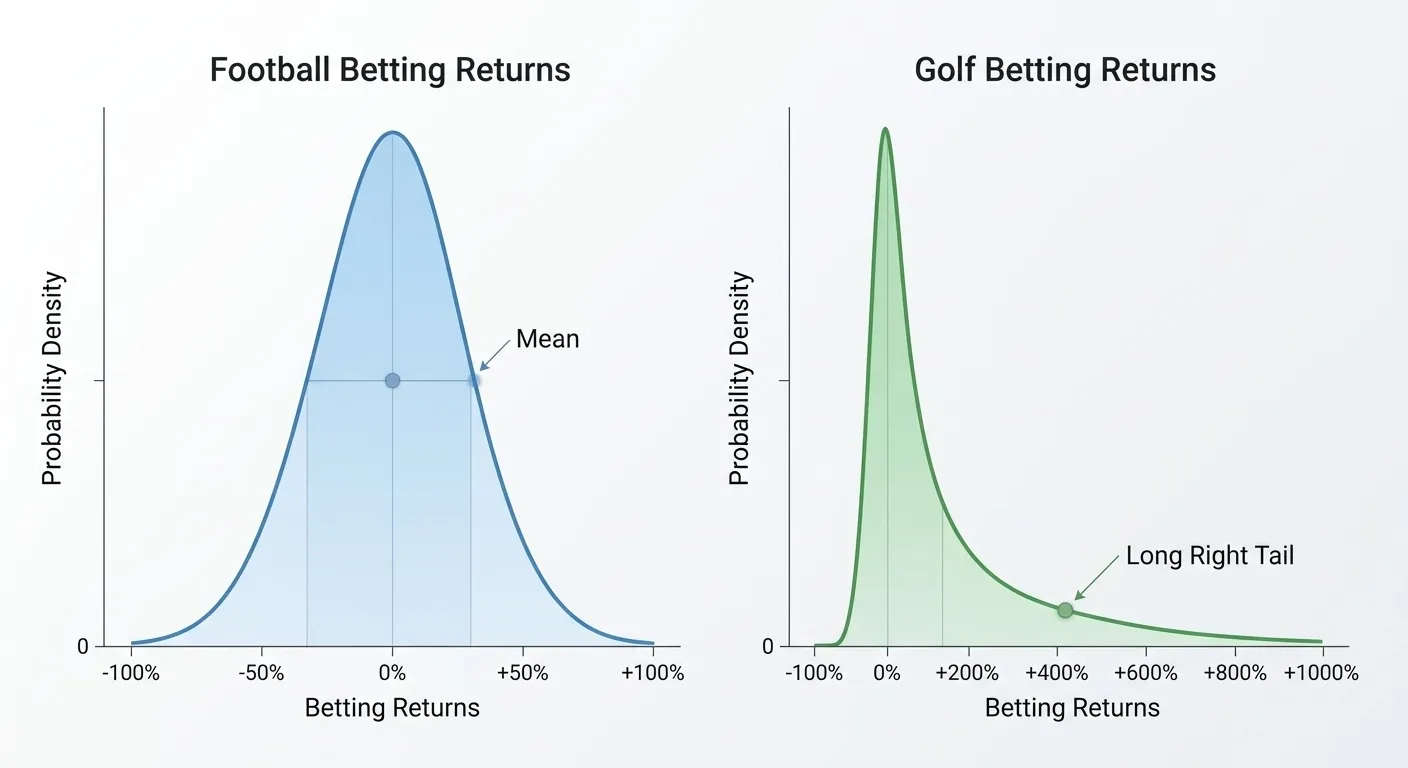
In football betting, a typical unit bet on a match has three possible outcomes and a resolution within 90 minutes. The probability of any single bet returning is generally between 30% and 65% — high enough that variance tends to smooth out across 30-40 bets reasonably quickly. A standard bankroll of 50-100 units with 1-2% staking is calibrated for that environment. In golf, a typical outright bet resolves over four days with one winner from a field of 150-plus players. The probability of any single bet winning is between 1% and 8% for a reasonably priced selection. The probability of achieving any return at all via each-way terms is between 6% and 15%. You can place 20 bets and return absolutely nothing. This happens to disciplined, systematic bettors in golf on a regular basis, and it has nothing to do with whether the system works.
Horse racing sits somewhere in between. An each-way horse racing bet on a 14/1 shot in a 16-runner field has roughly an 18-25% chance of producing a place return. Golf’s 40/1 each-way bet in a 156-man field with standard 5-place terms has roughly a 6-8% chance. The variance is three to four times higher, which means the required bankroll depth — to survive without distress — is proportionally larger. Golf also attracts disproportionately high-stakes bettors: 14% of UK golf bettors spend more than £100 per month on golf, versus 7% for football bettors. That concentration of serious money increases the commercial pressure on bookmakers and contributes to the restriction dynamic, but it also illustrates that the financial stakes of getting bankroll management wrong in golf are higher than in most other sports.
The other structural difference is the seasonal distribution of events. Football has matches every week across a long season, allowing for natural variance smoothing. Golf has 40-45 PGA Tour events and 35-40 DP World Tour events per year, with some overlap, some weeks off, and significant clustering around Majors. The density of betting opportunities is lower, which means each individual bet carries more weight in determining short-term results. A losing run that would represent 5% of a football season’s bets might represent 10-15% of a golf betting season. The psychological and financial impact is amplified.
How to Calculate Your Starting Golf Betting Bank: A Practical Framework
The question every new golf bettor asks is how much money they need to start. The honest answer depends on three variables: your target stake per bet, your expected volume of bets per year, and your risk tolerance for seeing that bank drop by 30-40% before it recovers. The last variable is the one most people underestimate.
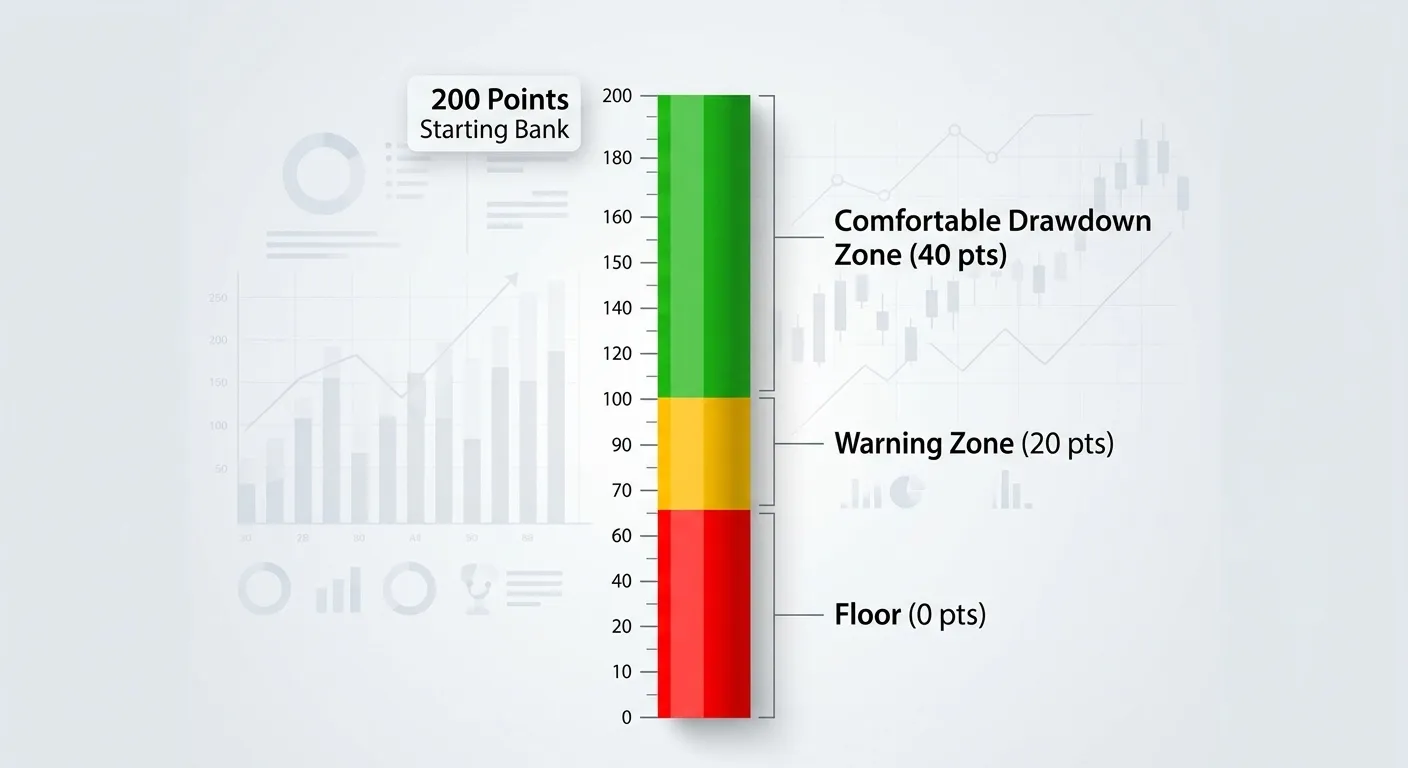
Start with the rule of minimum 100 points. A point is your standard unit stake. If your standard each-way bet is £10 total (£5 win / £5 place), one point is £10. A 100-point starting bank is £1,000. This is the floor, not the recommendation. With 100 points and a variance profile typical of each-way golf betting at 30/1-80/1, you will almost certainly experience a drawdown of 20-35 points at some stage in your first 100 bets. That is a 20-35% reduction in bank. At 100 points, that feels manageable. At 60 points, the same drawdown wipes out half your bank and forces you into decisions you do not want to make.
The better starting point — for a bettor placing 150-200 bets per year at consistent stakes — is 200 points. That gives you a drawdown cushion of 60-70 points (30-35%) before you even approach the point where you need to review whether your staking plan requires adjustment. It also gives you sufficient data — around 100 bets — to begin evaluating whether your system is performing to expectation before you need to make any structural decisions about the bank.
When calculating your bank in pounds, apply the golden rule of sports betting: never use money you cannot afford to lose entirely. The 200-point bank should represent disposable money that you have mentally written off. This is not pessimism — it is the correct psychological framing for systematic betting. If a 40-point drawdown triggers financial stress because that money was earmarked for something else, you will make suboptimal decisions under pressure. The correct approach is to treat the bank as investment capital committed to a specific strategy, separate from all other finances.
For bettors who are starting with a limited budget and want to maintain stakes that feel meaningful, there is a simpler formula: your maximum comfortable monthly loss is X. Your annual betting budget is 12X. Divide by 200 to get your point size. If you are comfortable potentially losing £100 in a bad month, your annual budget is £1,200, your point is £6, and your each-way stake is £6 total per bet. This keeps the financial exposure within a range you can sustain across the inevitable losing stretches.
Staking Plans for Golf Systems: Level Stakes, Percentage, and Kelly Variants
The staking plan debate in golf betting is genuine and the answer is not “whichever sounds most sophisticated.” Different plans are suited to different system types and bettor profiles. Let me be direct about what works, what does not, and why.
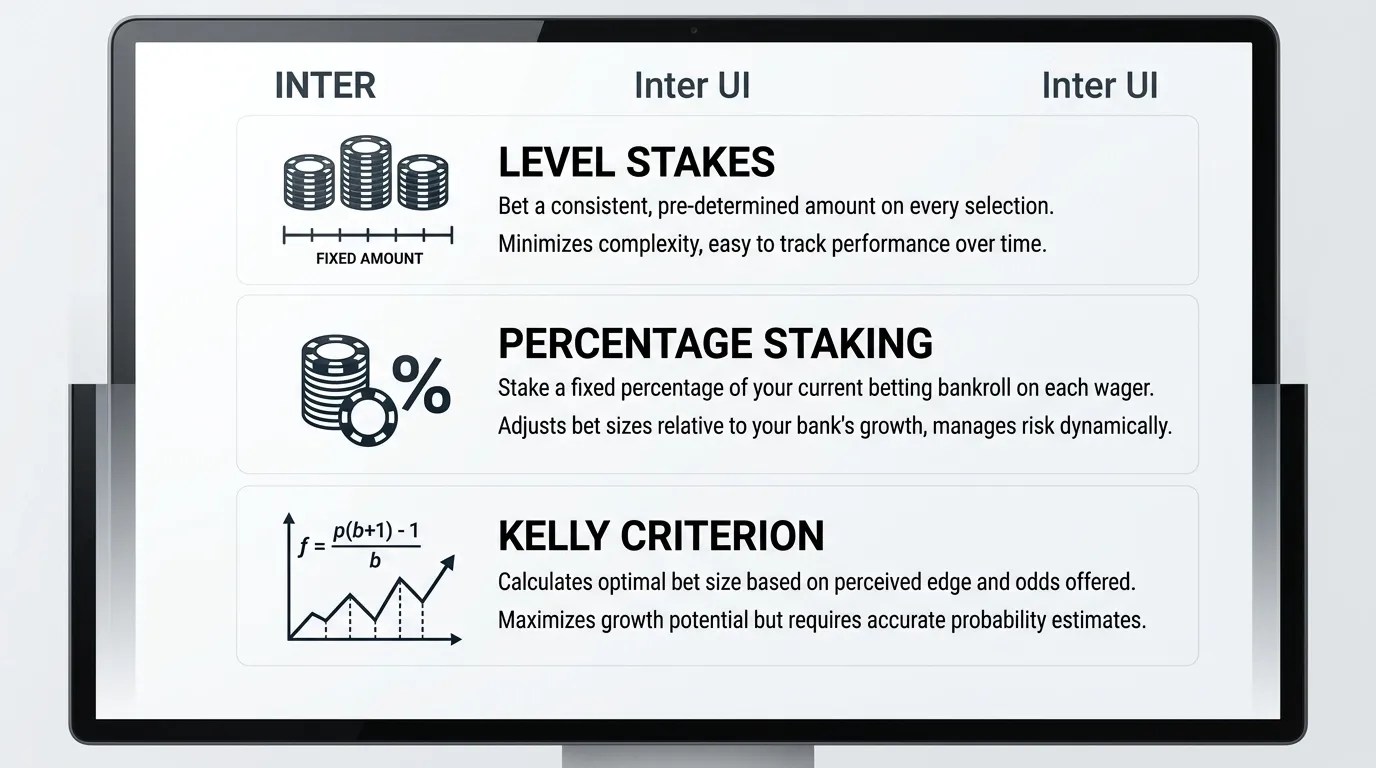
Level stakes — placing the same monetary amount on every qualifying bet — is the default recommendation for any bettor who is still building their model and has fewer than 200 bets of historical data. The reason is simple: level stakes makes system evaluation clean. If you place 200 bets at £10 each-way and record every result, your ROI calculation is unambiguous. Varying stakes by confidence level or price introduces a confounding variable that makes it very difficult to determine whether positive or negative results are attributable to your selection process or your staking choices. Until you have a robust data set, keep one variable constant. Make it stakes.
The percentage staking approach — placing a fixed percentage of your current bank on each bet — has intuitive appeal. As your bank grows, stakes increase proportionally, compounding your gains. As your bank shrinks, stakes reduce, slowing drawdown. In theory, this means you never go bust. In practice, for golf betting, percentage staking has a significant problem: the volatility of returns. If you are placing 1% of your bank per bet and your bank is 200 points, your stake is 2 points. After a 50-point drawdown, your stake is 1.5 points. The reduction in stakes during a drawdown feels responsible, but it also means that when the run of winners arrives — the 40/1 and 60/1 hits that all golf betting results depend on — your stakes are at their lowest. Percentage staking systematically reduces your stakes precisely when you are most likely to need them high to recover. For most golf bettors, this is a worse long-term outcome than level stakes.
The Kelly Criterion is the third commonly discussed approach, and it is the one I am most cautious about recommending without significant caveats. Kelly tells you to stake a proportion of your bank equal to your edge divided by the odds. If you believe a player is genuinely 5% to win and the market offers 28/1 (implied 3.45%), your Kelly fraction is roughly (0.05 – 0.0345) / 27 = 0.057%, which on a 200-point bank is 0.11 points. That is an almost invisible stake, because Kelly’s denominator — the odds — is very large for outright golf bets. Full Kelly at golf odds produces stakes so small they are operationally impractical for most bettors.
Fractional Kelly — typically 1/4 Kelly or 1/5 Kelly — is more practical. At 1/4 Kelly, the above example produces a stake of 0.028 points. Still tiny. The value of the Kelly framework for golf betting is not the precise stake size it generates — it is the relative ranking it produces. Running Kelly calculations across your candidate bets for a week gives you a rough confidence ranking: the bets where your model-vs-market discrepancy is largest get higher Kelly fractions, and you can use that ranking to allocate a fixed total staking budget across multiple selections. If you have £50 to stake in a week across three bets, the Kelly ranking tells you where to put more and where to put less, even if the absolute Kelly stakes are impractical.
My recommendation for most UK golf bettors: start with flat stakes at 1 point per bet (1/200th of bank for a 200-point starting bank). After 200 bets, evaluate your ROI and system variance. If your model shows consistent positive edge but with high variance, consider a modified approach where you designate “confident” selections — those with the largest model-vs-market discrepancy — as 1.5-point bets, while standard qualifying bets remain at 1 point. This introduces modest variation without abandoning the simplicity that makes level stakes so evaluation-friendly. Do not scale beyond 2 points for any single bet until you have 500+ bets of data and a demonstrated ROI above 5%.
Variance in Golf Betting: Why 200-Bet Samples Are Minimum for System Evaluation
This is the section most bettors do not want to read, because it tells them that the answer to “is my system working?” requires patience they do not have. But the mathematics are what they are, and ignoring them is expensive.
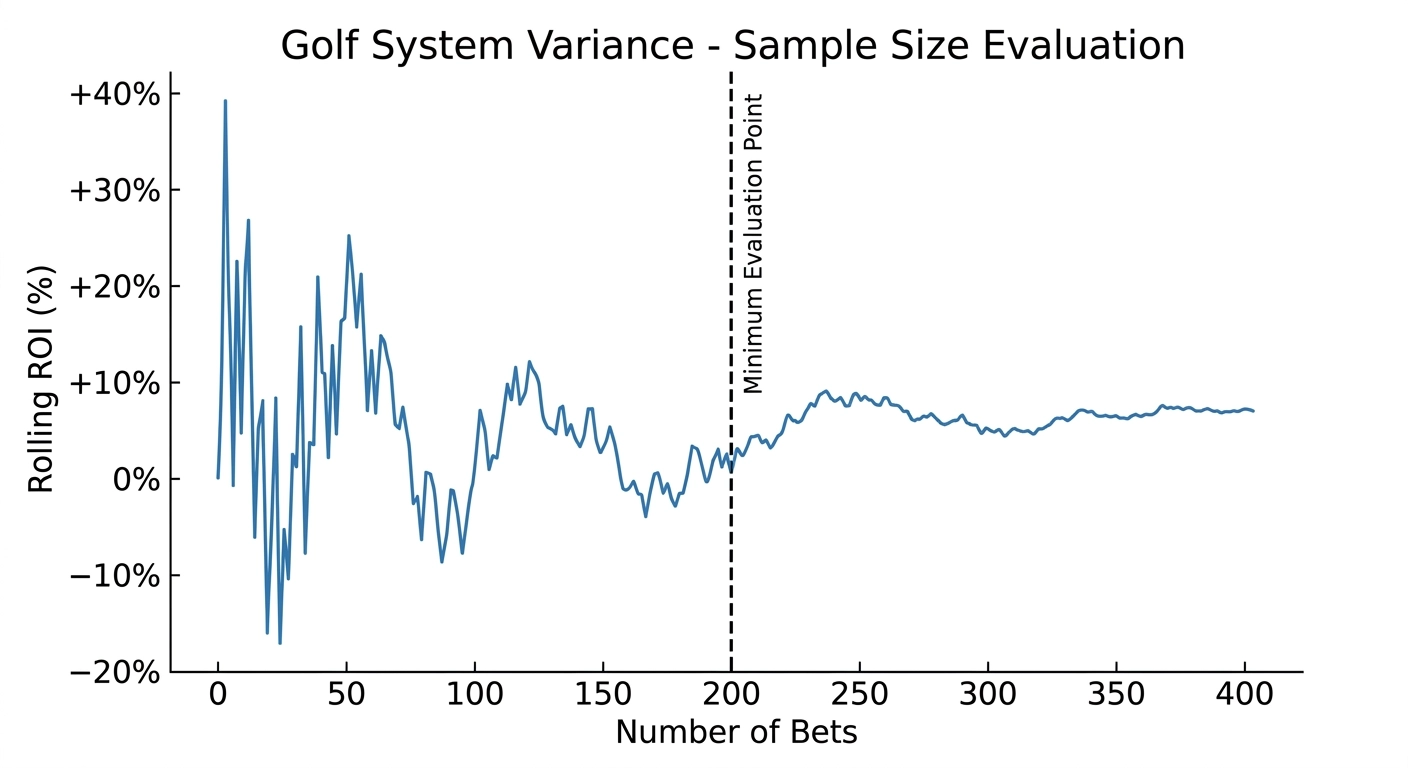
Consider a golf betting system with a genuine long-run ROI of 8%. What does the distribution of possible results look like after 50 bets? The range of outcomes — from unlucky to lucky — is enormous. A system with genuine 8% ROI can easily produce -20% ROI over 50 bets through variance alone. It can equally produce +35% ROI. Neither of these outcomes tells you whether the system works. They tell you that 50 bets is too small a sample to draw any conclusion.
The reason is golf’s return distribution. Most of your bets return nothing. A small number return at medium prices (5th place each-way at 40/1). An even smaller number return at high prices (winner at 60/1 or 80/1). The distribution is highly skewed. In a sample of 50 bets, whether you hit zero or one winner at 66/1 is largely luck, and the financial impact of that single result can swing apparent ROI by 50 points. Steve Palmer’s 2025 results illustrate this: 13 winners from 1,376 bets, including a 66/1 winner. If that 66/1 winner had not come in the same calendar year, the ROI would have dropped by approximately 4.8 percentage points — from 10.81% to roughly 6%. Same system, same selections, significantly different headline number. This is not a failure of the system. It is variance.
The practical standard I use: 200 bets before making any structural judgements about system performance. At 200 bets, you have seen enough variation to identify whether your return distribution is consistent with a positive-edge system or a negative-edge one. Even then, confidence intervals are wide — a 200-bet sample can still produce misleading results if the distribution was particularly unlucky with big-price winners. But it is the minimum credible evaluation window. At fewer than 100 bets, any conclusion you draw — positive or negative — is more likely to be noise than signal.
The implication for bankroll management is direct: your bank must be sized to survive 200 bets without being destroyed by an unlucky first 50. At a standard drawdown expectation of 25-35 points during any losing run, and with the possibility of a very unlucky stretch reaching 50+ points, a 200-point bank gives you 4-6 full bad-run drawdowns before hitting the floor. That coverage is what allows you to reach the 200-bet evaluation point with your system intact.
Staking Rules for Each-Way Outsiders: When High-Price Bets Distort Your Bank
The each-way structure interacts with bankroll management in ways that most bettors have not thought through carefully. The problem is this: when you bet each-way on a 100/1 shot and it wins, you do not collect one unit of profit. You collect somewhere between 50 and 100 units of profit in a single transaction. That event — which is genuinely exciting and deeply satisfying — creates a bankroll distortion that requires careful handling or it will corrupt your long-term system tracking.
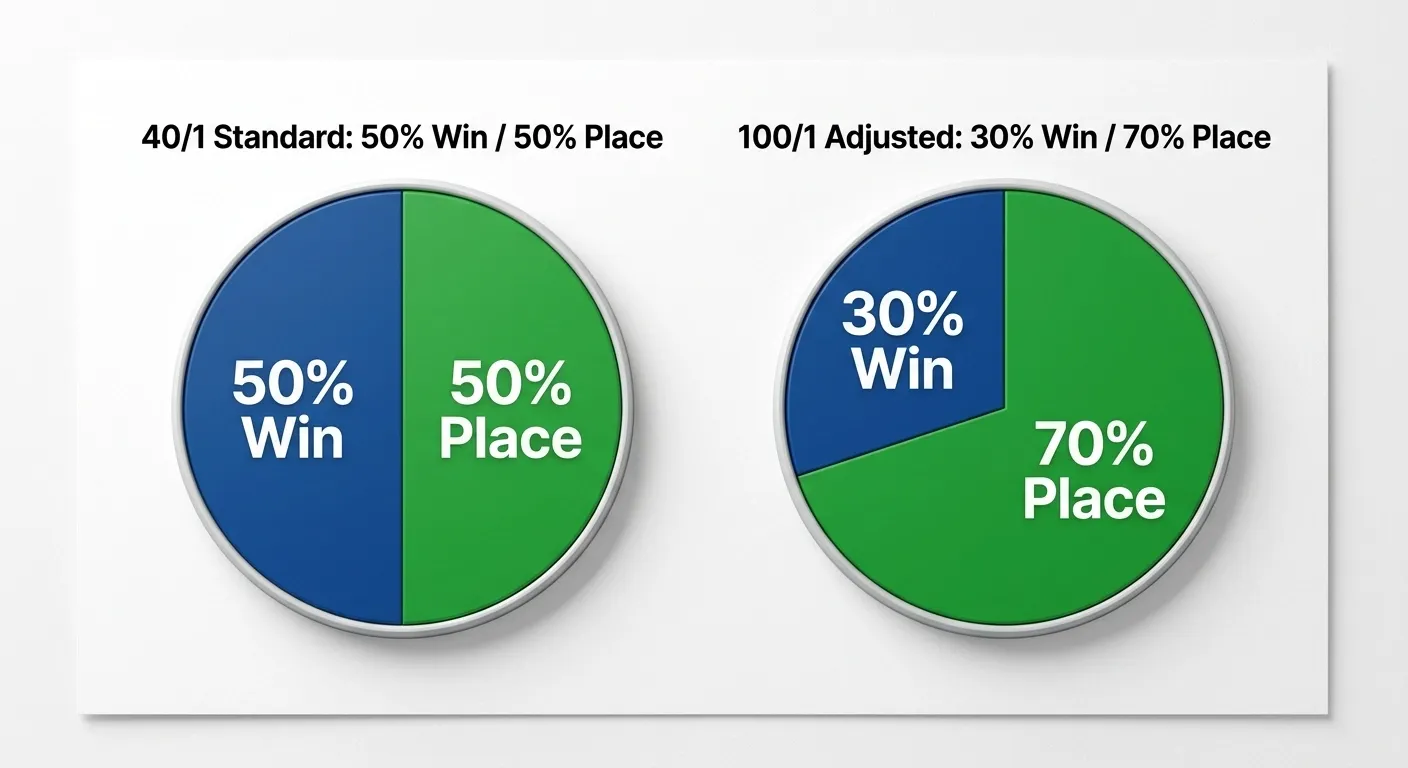
For bettors working with selections priced above 66/1, the standard approach is to slightly reduce the win stake relative to the place stake, as discussed in the each-way system guide. In bankroll management terms, the additional consideration is how to account for a very large win without letting it distort your ongoing staking. The danger is “house money” psychology: after a 60-point windfall from a 100/1 winner, the temptation to treat that money differently — as a buffer that allows higher stakes or more aggressive selections — is powerful and financially irrational.
The correct treatment of a large windfall is to absorb it into the bank as normal capital and continue with exactly the same staking plan. If your plan says 1 point per bet and your bank was 200 points before the winner, it is now 260 points (or wherever the net position sits). Your next bet remains 1 point. The only adjustment is if your bank has grown enough — say, to 280-300 points — that you have met a pre-specified bank growth milestone that triggers a planned stake increase. That milestone should be decided in advance, not reactively.
For an each-way system framework that covers the selection criteria and bookmaker terms feeding into these staking decisions, see our detailed guide to the each-way golf betting system — the bankroll rules here are the financial layer on top of that structural foundation.
Maximum Drawdown Rules: How to Know When Your System Has Failed vs. Hit a Cold Run
Every systematic bettor needs a pre-committed answer to this question: at what point do I stop placing bets and review whether the system is broken? Answering it reactively — in the middle of a losing run, when emotions are running high — produces bad decisions. Answer it now, write it down, and do not deviate from it.
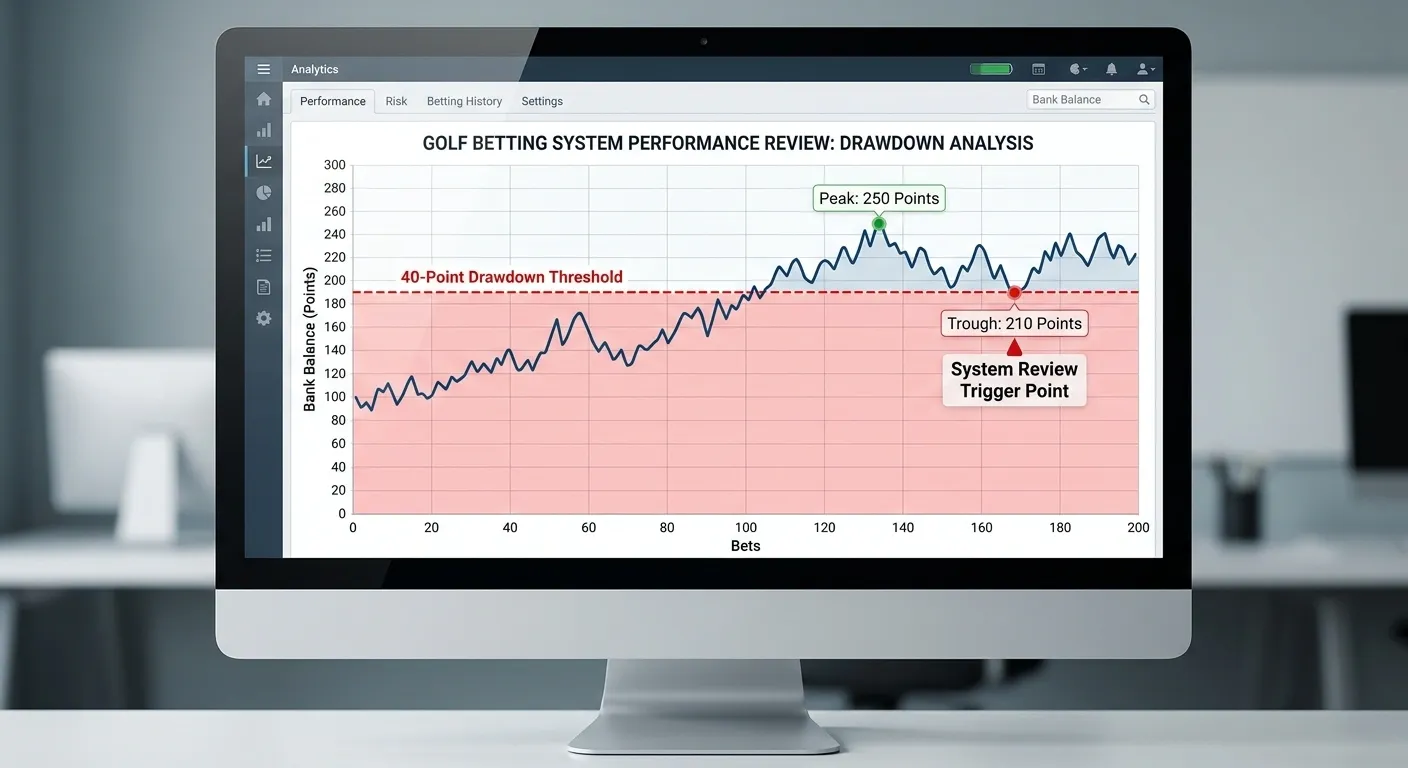
The standard maximum drawdown threshold I apply to golf betting systems is 40 points from any peak. If the bank reaches 200 points and then falls to 160 points — a 40-point drawdown — I stop placing bets at current stakes and conduct a formal system review. This review looks at three things: whether the selections since the last review have been consistent with the system criteria, whether there have been systematic errors (ignoring the selection filter, placing bets on insufficient research, missing better terms at other bookmakers), and whether the statistical analysis of results is consistent with a system experiencing normal variance or one that may have lost its edge.
Note that 40 points is not the point at which I conclude the system is broken — it is the point at which I pause and investigate. In most cases, a 40-point drawdown in golf betting represents bad variance from a still-viable system. The investigation typically confirms this, and bets resume at the same stakes. But the pause is necessary because it forces a structured review rather than an emotionally driven increase in stakes to “chase” the recovery.
The genuine system failure signal looks different from a bad variance run. It includes consistent failure to identify winners across a broad range of price points (not just in one segment), systematic losses in situations where your model showed the largest edge (which should theoretically be where you win most often), or evidence that the specific inefficiency your system exploited has been arbitraged away by market movement. If the review reveals any of these structural failure signals, the correct response is to reduce stakes significantly and continue data collection rather than abandoning the approach entirely.
Record Keeping for Golf Bettors: The Minimum Data You Need to Evaluate Your System
I have reviewed hundreds of golf betting records over the years, and the ones that tell you something useful have a consistent structure. The ones that just record win/loss and stake amount are almost worthless for system evaluation because they cannot answer the questions that matter: Where is the edge concentrating? Which parts of the system are underperforming? What is the ROI by price band, by tournament type, by bookmaker?
The minimum viable record for each bet contains: date, tournament name, player name, price at time of bet, each-way terms (places and fraction), bookmaker, stake (split into win and place), and outcome including finishing position. That is it. From this data, you can run every analysis that matters. You can calculate ROI by price band — are you making money at 40/1-80/1 but losing at 20/1-40/1? You can calculate ROI by bookmaker — are your bet365 bets outperforming BoyleSports bets or vice versa? You can calculate ROI by tournament type — are you better on Majors, regular events, or DP World Tour?
The record also needs a model estimate column: what probability did your model assign to this player before the bet? This allows you to compare your model probabilities to outcomes over time, which is the only way to identify whether your model is actually calibrated or systematically over or underestimating specific player types. A column noting whether you followed the pre-bet checklist (did you check each-way terms at multiple bookmakers, apply the course-fit filter, confirm your SG data was current) is also valuable — it helps you distinguish between system underperformance and execution errors.
Review your records after every 50 bets. Not weekly — the sample is too small — but every 50 bets. Calculate rolling ROI. Check whether any segment (price band, bookmaker, tournament type) is diverging significantly from expectations. After 200 bets, do a full system audit: recalculate overall ROI, compare to your starting expectation, and make any structural adjustments based on what the data shows.
Golf Bankroll Management: Questions Answered
The practical questions I get from bettors who are setting up systems for the first time tend to cluster around the same uncertainties. Here is the factual answer to each of the most important ones.
A starting golf betting bank should contain a minimum of 100 points, with 200 points as the recommended standard for bettors placing 150+ bets per year. The higher number provides sufficient drawdown cushion to reach the 200-bet minimum evaluation window without financial distress during an unlucky early run.
On the Kelly Criterion: it is mathematically optimal in the long run under idealised assumptions, but it is not suitable as a direct staking system for most golf bettors. At golf odds, full Kelly produces stakes that are operationally impractical. The value of Kelly for golf betting lies in using it as a relative confidence ranking across selections, not as a literal stake calculator. Start with flat stakes and introduce Kelly-based relative sizing only after you have a significant data set and confirmed positive ROI.
On statistical significance: this is uncomfortable to say, but 200 bets with positive ROI in golf betting is not yet statistically significant at conventional confidence levels. Golf’s return distribution is so skewed that you need 400-500 bets before a positive ROI can be attributed to skill with reasonable confidence. This does not mean stop at 200 bets if results are good — it means interpret them cautiously and continue building the sample. Treat the 200-bet review as a progress check, not a verdict.
Frequently Asked Questions
How many points should a starting golf betting bank contain?
The minimum is 100 points, but 200 points is the recommended standard for bettors placing 150 or more bets per year. A 200-point bank provides enough cushion to absorb a 40-50 point drawdown - which will happen to any golf betting system at some stage - without forcing panic decisions or premature system abandonment.
Is the Kelly Criterion suitable for golf betting systems?
Not as a direct staking method. At golf outright odds (40/1, 60/1, 100/1), full Kelly produces stakes that are operationally too small to be practical. The correct use of Kelly in golf betting is as a relative confidence ranking across candidate bets in a week - the selection with the highest Kelly fraction gets more of your weekly staking budget, but the absolute stake is determined by your flat-stakes framework.
How long does it take for a golf betting system to show statistically significant results?
A minimum of 200 bets before drawing any structural conclusions, and 400-500 bets before results can be attributed to skill with reasonable confidence at conventional statistical levels. Golf's highly skewed return distribution - many small losses, infrequent large wins - means variance remains high across surprisingly large sample sizes. The 200-bet milestone is a progress check, not a verdict.
Should you use the same stake size for each-way outsiders as for shorter-priced selections?
Not always. For selections priced above 66/1, consider slightly reducing the win stake and increasing the place stake relative to your standard split. For example, 30% win and 70% place rather than 50/50. This keeps total outlay constant while reducing the variance from a 100/1 winner that would otherwise generate a 50-100 point windfall and distort your bank accounting.
Golf Betting Guides
First Round Leader Golf Betting: A Systematic Approach to the FRL Market in the UK
The FRL market has a reputation problem. Casual bettors treat it as a novelty—a punt on who happens to have…
PGA Tour Betting Tips UK: How to Approach the World’s Deepest Golf Betting Market
The PGA Tour is, by a significant margin, the deepest and most efficiently priced golf betting market in the world.…
Each Way Extra Golf Explained: How to Decide When the Enhanced Terms Are Worth Taking
In 2025, bet365 offered 563 additional each-way places across golf events through their Each Way Extra feature. That's not a…
Best Golf Tipsters UK: How to Evaluate a Service Before You Follow Its Picks
I have a professional reluctance to recommend tipster services, not because they're all fraudulent—some are entirely legitimate—but because the evaluation…
