
Data-driven picks. Every fairway. Every week.
How UK Golf Betting Systems Actually Work — And Which Ones Produce Long-Term Profit
 Available in US

I remember the first time I placed what I thought was a "system" bet on golf. It was a Tuesday evening, I had a spreadsheet open, and I'd convinced myself that backing every player ranked inside the world top 20 each-way at 40/1 or better was a bulletproof plan. Nine months and a depleted bank account later, I understood the critical difference between a hunch with a spreadsheet attached and an actual betting system. The distinction matters more in golf than in any other sport.
Golf is the third most popular sport for UK bettors — 15% of online bettors placed a golf wager in the last 12 months, behind only football and horse racing. Yet the overwhelming majority of that money goes in without a systematic framework. Most punters follow a tip, back a familiar name, or pick whoever won last week. That is not a strategy. It is certainly not a system.
A genuine UK golf betting system has four interlocking components: a selection method with documented edge, an each-way structure that extracts value from place terms, bookmaker management that protects your accounts, and bankroll rules that keep you alive through the inevitable variance. Remove any one of those four and what remains is a guessing framework dressed in analytical language. What I've built over nine years of systematic betting on the PGA Tour and DP World Tour is not a magic formula — it's a process. This guide maps all four components and the data behind each one.
Six Numbers That Define Profitable Golf Betting in the UK
- Golf is the UK's third most popular betting sport — 15% of online bettors placed a golf wager in the last 12 months — yet systematic approaches remain rare.
- Each-way betting is the structural foundation: in 2025 alone, bet365 offered 563 additional each-way places beyond standard terms through its "Each Way Extra" feature.
- Strokes gained putting is consistently the weakest predictor of Major wins — ball-striking and approach metrics drive results, not the putter.
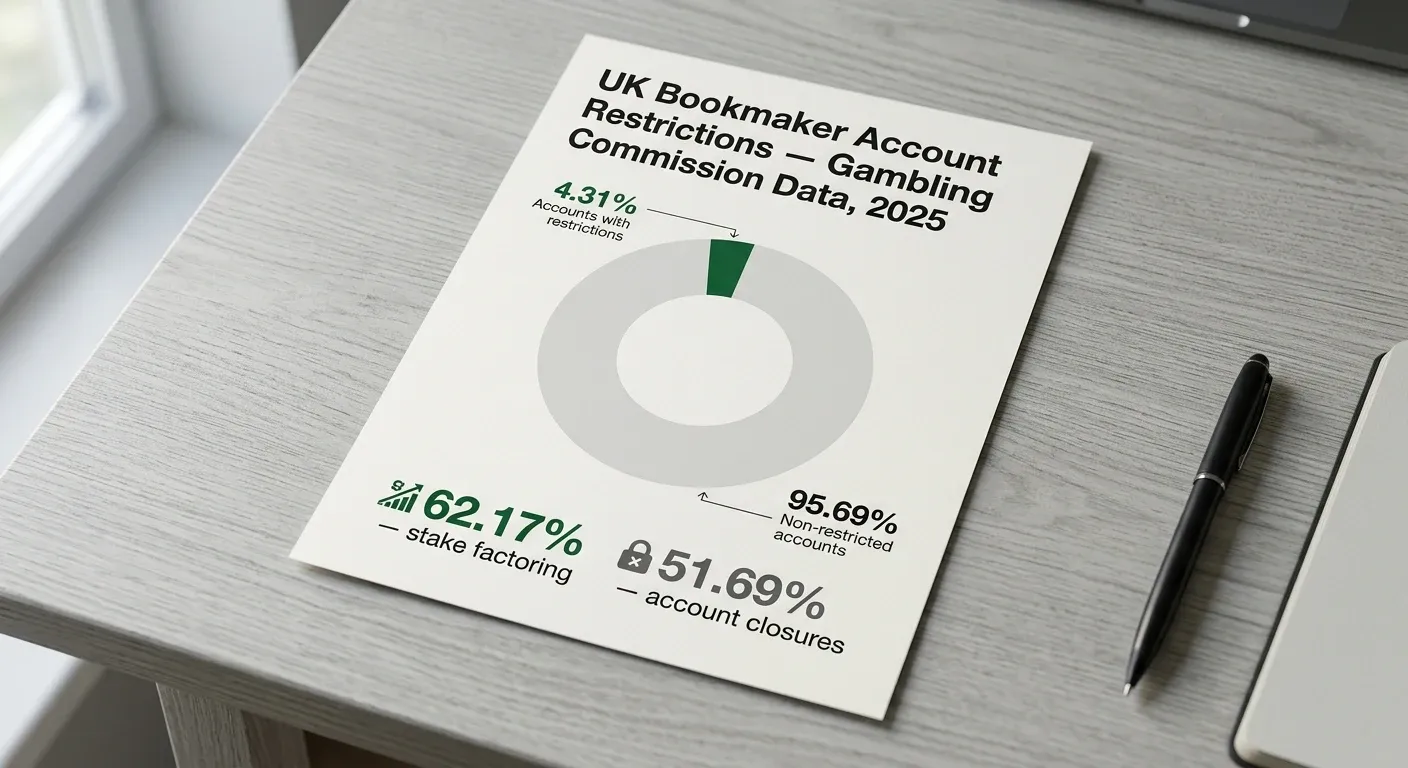
- 4.31% of active UK bookmaker accounts carry at least one commercial restriction. Protecting accounts is not optional; it's part of the system.
- A documented ROI of 10.81% across 1,376 outright golf bets in 2025 shows the ceiling is real — but it requires 200+ bets before your numbers mean anything statistically.
- The 2025 statutory gambling levy and October deposit-limit rules have changed the operating environment; understanding both protects your edge.
What a Golf Betting System Is — And What It Is Not
Ask ten bettors what a "system" is and nine of them will describe a strategy — a set of rules for picking selections. That conflation is where most systematic approaches fall apart before they begin. A strategy and a system are related but not interchangeable, and the distinction is not semantic hairsplitting; it determines whether your approach can actually be tested, refined, and profited from.
A betting system, in the strict sense, is a comprehensive method applied consistently across an entire category of bets — covering selection criteria, staking rules, market choice, and record-keeping. A betting strategy is any action that improves your odds of winning on a given bet. Put differently: all systems are strategies, but most strategies are not systems.
That definition matters practically. A strategy says: "Back players with strong strokes gained approach numbers this week." A system says: "Back players with top-10 SG:APP rankings over the last 24 rounds, on parkland courses with tight fairways, at odds between 25/1 and 80/1, each-way at 1/5 odds with seven places, staking 1% of bank per bet, and review performance every 50 bets." The strategy gives you a direction. The system gives you a decision tree you can run consistently and measure honestly.
The distinction also defines what you can learn from your results. If your selection method changes every week based on "feel," you cannot separate skill from luck in your records. You have no baseline to improve from. The system enforces consistency precisely so that over enough bets, the signal separates from the noise.
Edge — a positive expected value in a given betting market; the mathematical advantage a bettor holds over the bookmaker's implied probability on a specific selection or category of selections. Without documented edge, no system produces long-term profit regardless of how sophisticated its other components are.

In golf, three categories of system exist in practice. The first is the each-way outright system — the most common and the one with the most thoroughly documented track records among UK bettors. The second is the data-driven model approach, which uses strokes gained metrics to identify players whose implied win probability in the market is lower than the model's estimate. The third is the course-fit overlay, which does not try to beat the market on player quality but on course suitability — finding players whose game profiles match the specific demands of a given track that week.
Most durable golf betting systems in the UK blend all three. The each-way structure captures value from place terms. The data layer identifies which players warrant attention. The course-fit filter narrows the shortlist to those with genuine positional justification at that week's venue. The bankroll and bookmaker management layer is what allows the system to survive the inevitable losing stretches. And what a golf betting system emphatically is not is a guarantee of profit on any given week, month, or quarter. The variance in golf — where a 144-man field competes over 72 holes and a single lucky bounce can determine the winner — means that even a system with genuine edge will produce losing runs of 20 or 30 bets without it indicating anything is wrong. The system's job is to ensure that when you run enough bets, the numbers eventually reflect your actual edge, not just your recent fortune. But why does golf — specifically — reward this kind of systematic patience better than other sports?
Why Golf Is the Sport Where Systems Consistently Outperform Guesswork
Golf's structural properties — the ones that make it seem chaotic and unpredictable — are precisely what makes it fertile ground for systematic bettors who know how to separate signal from noise. The answer lies in three compounding advantages: audience concentration, market inefficiency, and the each-way structure.
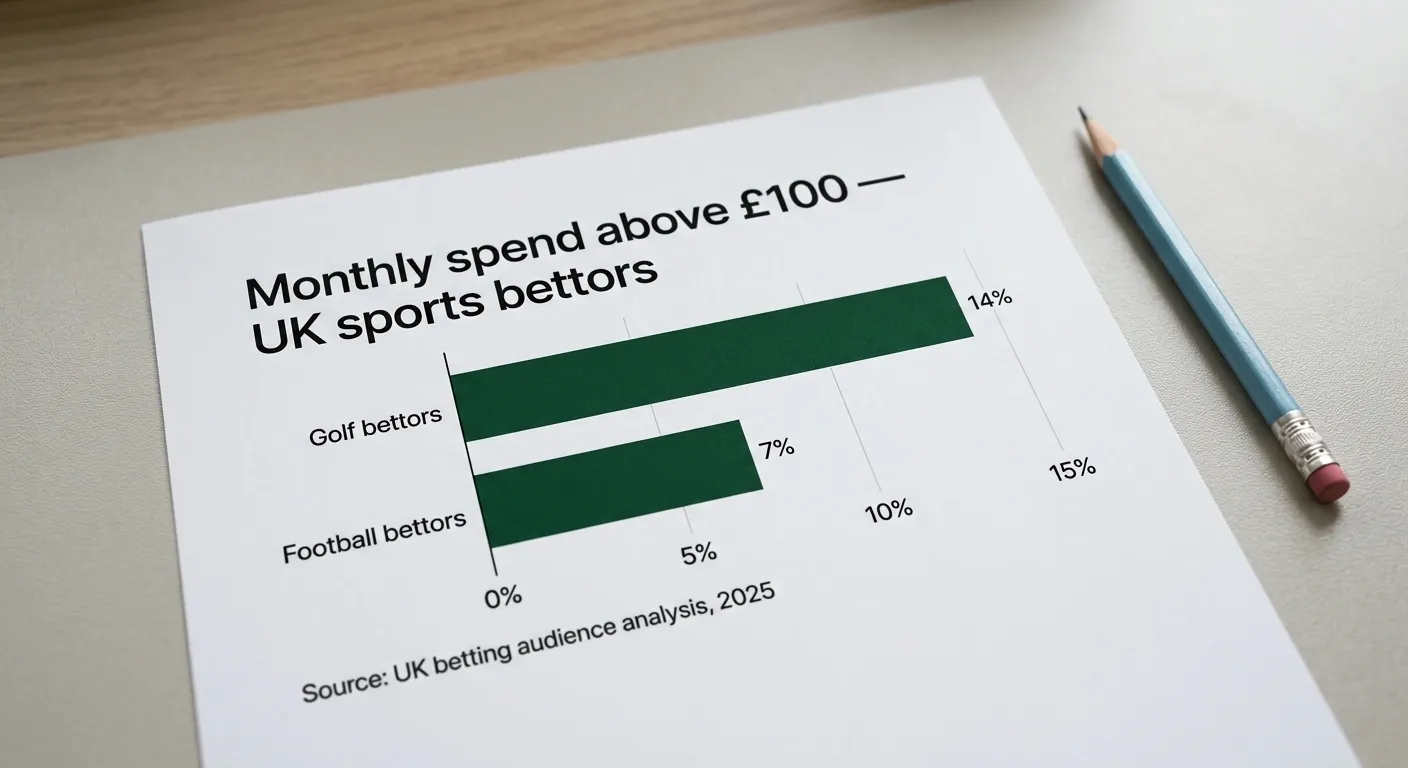
Golf attracts a disproportionately high-stakes audience. Among UK bettors who wager on golf, 14% spend more than £100 per month — double the equivalent rate among football bettors (7%). That concentration of serious money does not automatically produce efficient markets. In fact, the opposite often holds: large fields, long price ranges, and the complexity of the sport mean that bookmakers' models carry meaningful errors in the 25/1–80/1 range where most each-way value concentrates. Those errors are systematic — which means they are exploitable by systematic analysis.
14% of UK golf bettors spend over £100 per month — twice the rate of football bettors. The same audience that generates significant bookmaker revenue is also the one most likely to develop systematic approaches. That dynamic creates tension that experienced bettors can use.
The predictability argument is more nuanced than most bettors realise. Golf is a noisy sport — a large proportion of any given round's variation is essentially random. That's not a reason to abandon systems; it's a reason to build systems that work over large samples rather than expecting weekly fireworks. The metrics that do predict results — primarily ball-striking and approach quality, measured through strokes gained — are stable enough to form the basis of repeatable selection criteria. A player who ranks consistently in the top 20 in SG:Approach over 24 rounds does not become a different golfer on a given Thursday, even if their leaderboard position varies wildly week to week.
Golf's field sizes
Typical PGA Tour field: 132–156 players. Large fields mean long prices and structurally higher place term value than most other sports.
Market inefficiency window
Bookmakers set outright prices early in the week, before weather, course conditions, and practice rounds are factored in. Informed bettors who act on Tuesday prices can capture value that disappears by Thursday morning.
Data advantage
Strokes gained analytics are publicly accessible at granular levels for the PGA Tour. Most market participants don't use them — that asymmetry in application creates edge from public data.
The deeper structural reason golf suits systems is the each-way market itself. In no other major betting sport does the number of places paid — and the odds fraction — vary so significantly between bookmakers and between tournaments. That variation creates a systematic advantage for bettors who track those terms week by week, without requiring any unusual prediction accuracy. The following sections map exactly how to build that advantage.
Each-Way Betting: The Structural Foundation of Every Serious UK Golf System
I've analysed dozens of profitable long-term golf betting records from UK bettors, and the consistent finding is this: almost all of them are built on each-way structures. Not because each-way is the only way to make money on golf, but because the UK bookmaker landscape has developed enhanced place terms — particularly in the 25/1–80/1 range — that create a structural advantage simply not available in outright markets. Understanding why requires understanding what each-way betting actually does to the expected value equation.
An each-way bet is two bets in one: a win bet and a place bet at the same stake. The place portion pays out if your selection finishes within a specified number of places — typically top 5 for standard tournaments, with enhanced options reaching 8, 10, or even 12 places. The place payout is calculated at a fraction of the win odds: usually 1/4 or 1/5. At 40/1, a £10 each-way bet (total £20 staked) pays £410 for a win (10 x 41) plus £90 for a place (10 x 40/4 + 10). The place portion alone returns 4.5x your place stake at 1/4 odds.
The math becomes transformative when you combine long prices with enhanced place terms. A player at 66/1 finishing fifth at a standard 5-place, 1/5-odds event returns your place stake at 14.2x. The same player at an event where a bookmaker offers 10 places at 1/5 odds returns the same amount — but your probability of triggering that return has roughly doubled. You haven't changed the selection. You've changed the market, and in doing so, you've fundamentally altered your expected return without changing your risk assessment of the player.
This is where the UK bookmaker competition for golf traffic has, paradoxically, benefited serious bettors. In 2025, bet365 offered a record 563 additional each-way places beyond the standard five-place terms across PGA and DP World Tour events through its "Each Way Extra" feature. In the 2024 season, it offered 555 — the first time it had exceeded the BoyleSports total. Coral, meanwhile, has offered standard 10-place terms at 1/5 odds on all full-field PGA Tour events every week since 2017, when it became the first bookmaker to extend 10 places to Major championships. In 2025, BoyleSports reclaimed its position at the top of the additional-place tracker through its "Pick Your Place" feature, which offers the choice of 6, 10, or 12 places at 1/5 odds on Major Championships.
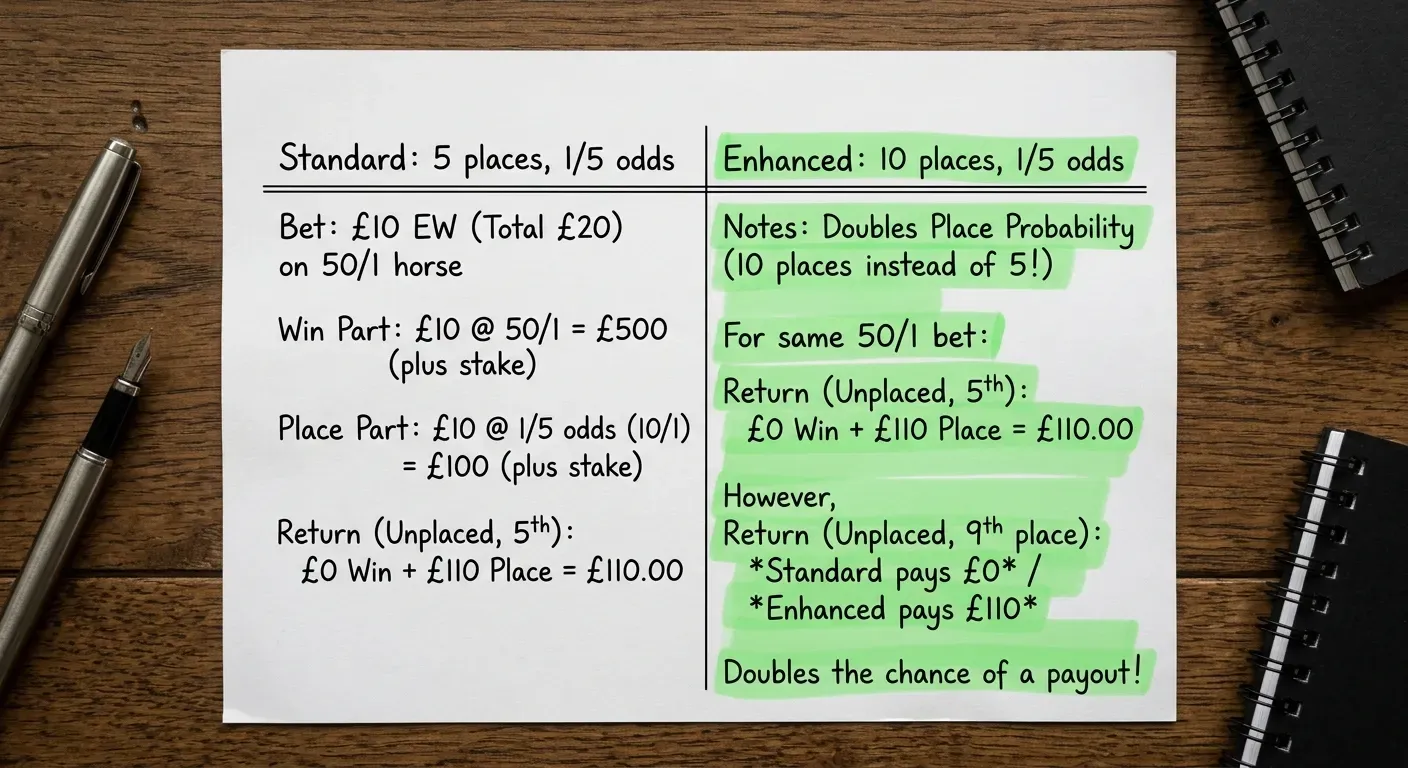
Each-Way Place Term Comparison — Same Player, Different Markets
Player priced at 50/1. Stake: £10 each-way (£20 total).
Standard terms (5 places, 1/5 odds): Place pays 10/1. Return if placed: £110.
Enhanced terms (10 places, 1/5 odds): Same return per occurrence — but probability of placing roughly doubles. Expected return roughly doubles without changing the odds.
Enhanced terms (8 places, 1/4 odds): Place pays 12.5/1. Return if placed: £135 — 25% higher per occurrence than 1/5 terms.
Conclusion: which bookmaker you use, on which event, on which terms is not housekeeping. It is a core system variable that directly determines expected return on every bet.
What does this mean in practice? It means bookmaker selection is a weekly process — identifying which market gives the best combination of places and odds fraction on each specific event, and sometimes splitting stakes between operators offering different terms. The each-way golf betting system covers the mechanics in detail, including how to track place terms across a full season.
One important nuance: 1/4 versus 1/5 odds is not always won by 1/4. If a bookmaker offers 1/5 odds with 10 places while another offers 1/4 odds with five, the 1/5 offer is often superior for outsiders — the doubled place probability more than compensates for the lower odds fraction. The calculation depends on the player's price and your estimate of their finishing distribution. A system includes this calculation. A strategy leaves it to intuition.
Bookmaker Selection as a System Component: Where Each-Way Value Actually Lives
The question I'm asked most often by bettors moving from casual to systematic is: which bookmaker should I use? It's the wrong question. The right question is: for this specific tournament, this field size, and this price range, which bookmaker offers terms that give me the best expected return? The answer changes week by week, and treating bookmaker selection as a fixed decision rather than a weekly variable is one of the most expensive mistakes a golf bettor makes.
In 2026, with data running through April, bet365 and BoyleSports are running neck-and-neck for additional each-way places offered, significantly ahead of Sky Bet and Paddy Power. That gap is not minor. Over a full season, it can represent dozens of additional place positions across the portfolio — a material impact on overall returns that is invisible to bettors who simply pick a preferred bookmaker and stay with it.
| Feature | Standard Market | Enhanced Leader (2026) |
|---|---|---|
| PGA Tour — regular events (places) | 5 places, 1/5 odds | Up to 10+ places via EW Extra / Pick Your Place |
| PGA Tour — Major championships (places) | 5 places, 1/5 odds | 10–12 places at 1/5 (BoyleSports Pick Your Place 12 places) |
| Odds fraction on places | 1/5 (most common) | 1/4 (selected bookmakers, certain events) |
| Consistency of enhanced terms | Variable — announced weekly | Track record required — varies by operator |
| Additional places 2025 (full season) | — (baseline) | 563 additional places (bet365 EW Extra, 2025) |

The architecture of a multi-bookmaker setup is not about arbitrage. It's about ensuring that for any given week's selections, you can access the best available terms. That means maintaining active, healthy accounts across multiple operators and managing them carefully enough that you don't get restricted before your system produces meaningful data.
One practical note: the enhanced terms from "Each Way Extra" and "Pick Your Place" are not guaranteed in advance — they're offered week by week, with places varying by event. Coral's 10-place terms are more predictable — offered on all full-field PGA Tour events every week, a structural feature rather than a promotional one. For systematic bettors, that predictability has value: you can build staking calculations around it in advance. For a real-time breakdown of current terms, the golf betting each-way bookmakers guide tracks the data across the season.
Strokes Gained as the Analytical Engine of Modern Golf Betting Systems
Matt Courchene, the co-founder of DataGolf — the analytics platform that has become the benchmark for serious golf modelling — put it plainly in a 2025 interview: "Golf is noisy: most of the variation in any given day's score is unpredictable... The hardest thing about forecasting golf is finding what's actually predictable." If you can identify the metrics that are actually predictable, you've found your analytical engine.
Strokes gained is the statistical framework that makes that identification possible. Rather than measuring performance in absolute terms — scorecard figures that include course difficulty and field quality — strokes gained measures each component relative to the Tour average. SG:Approach measures value created from approach shots. SG:Off-the-Tee captures driving performance. SG:Around-the-Green measures short-game prowess. SG:Putting measures putting efficiency. Each category isolates a distinct skill set, allowing analysis impossible with traditional statistics.
Strokes gained works by comparing each shot's outcome to the average number of shots a Tour player would take to complete the hole from that position. A player who hits an approach to 8 feet from 180 yards "gains" strokes against the average player, who might leave that same approach 25 feet away. Aggregated across an entire round, and then across multiple rounds, SG gives you a stable picture of where a player's game genuinely sits — not what their scorecard says this week, but what their shot-quality says they should be producing.

For betting applications, the hierarchy of SG categories matters enormously. Analysis of Fried Egg Golf's approach data from Augusta National shows that shots gained on approach accounted for approximately 30% of the winning advantage among players finishing in the top 5 at the Masters over five years — and in four of those five seasons, approach play influenced results more than putting. DataGolf's own analysis from 2026 confirms this at the tournament level: none of the five most recent Masters winners ranked inside the top 10 in their field for SG:Putting. The winners were ball-strikers and approach players, not putters.
SG:Approach-the-Green (SG:APP) — the most predictive single strokes gained category for identifying outright winners on standard PGA Tour parkland courses. Measures approach shot quality from all distances into the green, net of course difficulty. Consistently high SG:APP correlates with top-10 finishes more reliably than any other individual SG metric.
How does this translate into a system? It doesn't replace judgement — it structures it. My own approach uses a 24-round rolling SG window as the primary filter. A player ranking in the top 30 for SG:APP across 24 rounds who is available at 40/1 is worth a systematic look. The same player ranked top 30 in only their last three events is much noisier data — hot runs in golf are almost always mean-reverting. The model comparison then becomes the actionable layer: when your probability estimate for a player diverges materially from the market's implied probability, you have a decision. When it doesn't, you don't bet. That discipline is what the system enforces. For a deeper methodology on translating SG data into selections, the strokes gained golf betting guide covers the full framework.
Course Fit: How Matching Player Profile to Track Separates System Bettors from Guessers
The week before the Masters every year, punters back players who are in good form without asking the question that matters: good form for what? Augusta National rewards creative ball-strikers who can flight the ball into elevated greens and manage precise distance control — a player dominating flat, benign parkland layouts may simply not have the game profile Augusta demands. Course fit is not a soft qualitative factor. It's a filterable, data-supported variable that narrows your selection pool to players whose documented skills match the specific demands of a given track.
Course Fit Framework: Four-Variable Filter
Step 1: Course archetype classification. Is the course a bomber's track (long, wide, premium on driving distance) or a precision layout (tight, shorter, premium on iron play and approach accuracy)? Links courses in particular — from Royal Portrush to Carnoustie — favour creativity, low trajectory, and wind management over the approach skills that dominate on PGA Tour parkland.
Step 2: Identify the critical SG category for this course type. At Augusta National, SG:Approach dominates. At a typical links Open qualifier, SG:Off-the-Tee and SG:Around-the-Green matter more than at most events. At Sawgrass (The Players), the premium is on precision iron play and accurate driving. Map the course to its primary SG driver before you look at a single player.
Step 3: Filter candidates by SG profile, not leaderboard. Find players who rank in the top quartile of the field for the relevant SG categories over the last 24 rounds. These are your structurally qualified candidates. A player finishing 40th last week with strong SG:APP numbers is often a better course-fit candidate than someone who made the top 10 but generated most of their score through hot putting.
Step 4: Apply course history weighting. DataGolf's Course History tool confirms what professionals have long observed: course history carries more predictive weight at Augusta than at almost any other PGA Tour event. Players who have placed consistently at a given venue across multiple editions are not simply "getting lucky" — they have game profiles that suit the course's specific demands. Five to seven previous starts is the minimum for course history to be statistically meaningful.

The course history weighting point deserves emphasis because it is frequently misapplied. At Augusta, creative ball-strikers have dominated historically — Hideki Matsuyama, Tiger Woods, Sergio Garcia, Bubba Watson, Phil Mickelson — not because they are the best golfers in the world in an absolute sense, but because their playing styles match Augusta's specific requirements for curve management and approach angle. That pattern is durable data. When one of those profile types is available at a price the market hasn't fully adjusted for, course fit gives you the analytical justification to act.
The full systematic framework — how to build an SG overlay on a course archetype, how to weight links vs. parkland differences, how to handle Majors where course fit exerts its strongest influence — is in the course fit golf betting guide. The principle for pillar purposes: characterise both the player's game profile and the course's profile before any selection. If you can't articulate specifically why this player suits this track this week, the bet is a hunch, not a system pick.
Bankroll Management Rules That Keep Golf Betting Systems Alive Long-Term
Steve Palmer, whose 2025 outright golf betting record stands as one of the best publicly documented long-term golf betting results in the UK — ROI of 10.81%, 148.70 points profit from 1,376 bets placed, 13 winners including prices of 66/1, 60/1, and three at 40/1 — has survived just three losing years in nearly three decades of betting on golf. That record is not just evidence of selection quality. It's evidence of bankroll discipline so rigorous that the inevitable losing runs never threatened the enterprise. Without the latter, the former is meaningless.
Golf betting has a variance profile unlike almost any other sport. In a 156-man field, even a player with a genuine 10% win probability will fail to win 90% of the time. Running a series of bets in the 25/1–80/1 range means that losing streaks of 30, 40, or even 50 consecutive outright bets are statistically normal — not evidence of a broken system. Your bankroll rules must be built around this reality, not around the fantasy that a good system will deliver regular winners.
Pre-Bet Bankroll Checklist
- Is this bet sized at 1–2% of my current total bank? (Never exceed 2% on a single outright golf selection regardless of confidence.)
- Have I calculated the maximum consecutive losers my current bank can absorb at this stake size before dropping below 50% of starting bank? (It must be at least 40 bets.)
- Does my system have more than 200 recorded bets, allowing statistically meaningful ROI evaluation? (If not, I'm still in the calibration phase — reduce stakes further.)
- Have I placed this bet at the best available each-way terms for this event, not just my default bookmaker?
- Is my record of this bet logged immediately — selection, odds, each-way terms, market, stake, date, and tournament — before I move on?

The most common reason profitable golf betting systems fail is not selection quality. It's staking. A bettor who increases stakes after a winning run (chasing higher profits) and reduces them after a losing run (chasing their losses back) systematically destroys their own edge by buying expensive bets and selling cheap ones. Level stakes — or percentage-of-bank stakes that adjust only with significant bank movements — remove that temptation by making the staking decision in advance, not in the emotional aftermath of results.
The starting bank calculation for a golf betting system depends on the price range you operate in. For a system centred on 25/1–80/1 each-way selections, a minimum of 100 points (where one point equals your standard stake) is the operational floor — and 150 points before you consider the system properly capitalised. Below 100 points, a normal variance run at 2% stakes brings you below 60% of your starting bank within a handful of unlucky events, at which point psychological pressure compromises decision-making. The golf betting bankroll management guide covers staking plan variants — level stakes, percentage, and Kelly fraction — with worked examples for each-way outsider portfolios specifically.
Account Restrictions: The Inconvenient Truth Every UK Golf Bettor Must Understand
I've watched bettors spend months building a profitable golf betting system and then lose half their edge overnight because three of their five bookmaker accounts got stake-factored simultaneously. They'd done everything else right — they simply hadn't treated account management as a core system variable. The data from the Gambling Commission makes the scale of this issue impossible to ignore.
The Commission's July 2025 blog disclosed figures from a data request across the UK's largest online operators: out of 14,923,840 active customer accounts, 643,779 — 4.31% — carried at least one commercial restriction. Of those, 62.17% were subject to stake factoring (reducing the maximum permitted stake to a fraction of the standard limit). A further 51.69% of restricted accounts were closed on commercial grounds.
Andrew Rhodes was clear about the regulatory position on account restrictions in his July 2025 blog: "Operators have the right to act in their own commercial interests and manage their liabilities. It is not within our regulatory remit to dictate to operators how they manage their commercial liabilities." In practical terms: bookmakers can restrict winning accounts, and the regulator will not stop them. The burden of account management falls entirely on the bettor.
✓ Do
- Open accounts gradually and spread your activity across at least five to seven different bookmakers from the start.
- Place occasional recreational-looking bets — small accumulators, in-play bets, non-golf markets — alongside your systematic selections to create a mixed account profile.
- Use betting exchanges for selections where you need significant stake and cannot afford to be restricted; exchange accounts cannot be stake-factored.
- Keep detailed records of your account status at each operator — maximum permitted stakes, stake factors applied, date of any notification.
- When you receive a restriction, adapt your system immediately: remove that account from your active rotation for systematic bets and use it only for low-risk recreational activity.
✗ Don't
- Bet at or close to the maximum limits on every account every week — this is the clearest signal to a bookmaker's risk team that you are a systematic bettor.
- Request account reviews or complain about restrictions in ways that draw attention to your profile.
- Chase maximum each-way place terms from the same bookmaker on every single event — vary your selections across accounts.
- Assume that using a VPN, a different device, or a family member's account will protect you from detection; the consequences can extend to account closure and fund confiscation.
- Neglect to check Betfair Exchange and Smarkets as genuine alternatives when your fixed-odds account options are compromised.
The restriction problem is real, it is growing, and no UK golf betting system can afford to ignore it. Build your account management strategy before your first systematic bet, not after your first restriction notice.
Beyond Outrights: Which Golf Betting Markets Give Systems the Best Edge
Outright betting is where the biggest prices live and where each-way structures generate the highest absolute returns. But it's not the only market where systematic golf bettors can build edge — and in some cases, particularly when your outright accounts are under restriction pressure, other markets offer better risk-adjusted opportunities. Here's how I categorise the main options.
Outright Each-Way
The primary market for serious UK golf systems. Large fields, enhanced place terms, and predictable price ranges create consistent opportunities. Variance is high — treat this as your main bank with 200+ bets before evaluating ROI.
First Round Leader
FRL markets are interesting because first-round performance is partly decoupled from overall tournament ability. Tee time matters — morning starters often benefit from benign conditions. SG:OTT and SG:APP both apply, and the 52-event annual sample is workable for system evaluation.
3-Ball Betting
Head-to-head matchup markets within grouped threesomes. Bookmakers set these based on overall tournament pricing, creating mismatches where one player has a pronounced course-fit advantage over the others. Harder to restrict and looks recreational. An excellent secondary market for accounts under pressure.
Top Nationality Markets
Top American, top European, top Englishman. These markets attract nationality sentiment rather than analytical money, creating pricing errors around underrated players. Relatively low bookmaker margin compared to outrights.
Make/Miss the Cut
Highly accessible for systematic SG application. Players with consistently strong strokes gained numbers miss cuts at far lower rates than the price implies. Better for accounts with outright stake restrictions.
Round-by-Round Scores
Over/under total score markets for a specific round. Weather-dependent and harder to systematise from a Tuesday position, but useful when conditions create clear deviations from standard scoring averages.

The market hierarchy for a systematic bettor follows a clear logic: prioritise markets where your selection data has the most predictive power, where bookmaker margin is lowest, and where restrictions are least likely to be triggered quickly. Outrights check the first criterion but carry the highest restriction risk. 3-balls check all three. The optimal system uses outrights as the primary vehicle and 3-balls as the managed secondary market for accounts restricted in outright maximums. Understanding that restriction risk also requires understanding the regulatory landscape those bookmakers operate in.
UK Regulatory Context: What the 2025 Gambling Act Changes Mean for Systematic Bettors
Two regulatory changes from 2025 are directly relevant to UK golf bettors running systematic approaches, and both tend to get overlooked by bettors focused on selection rather than the operating environment.
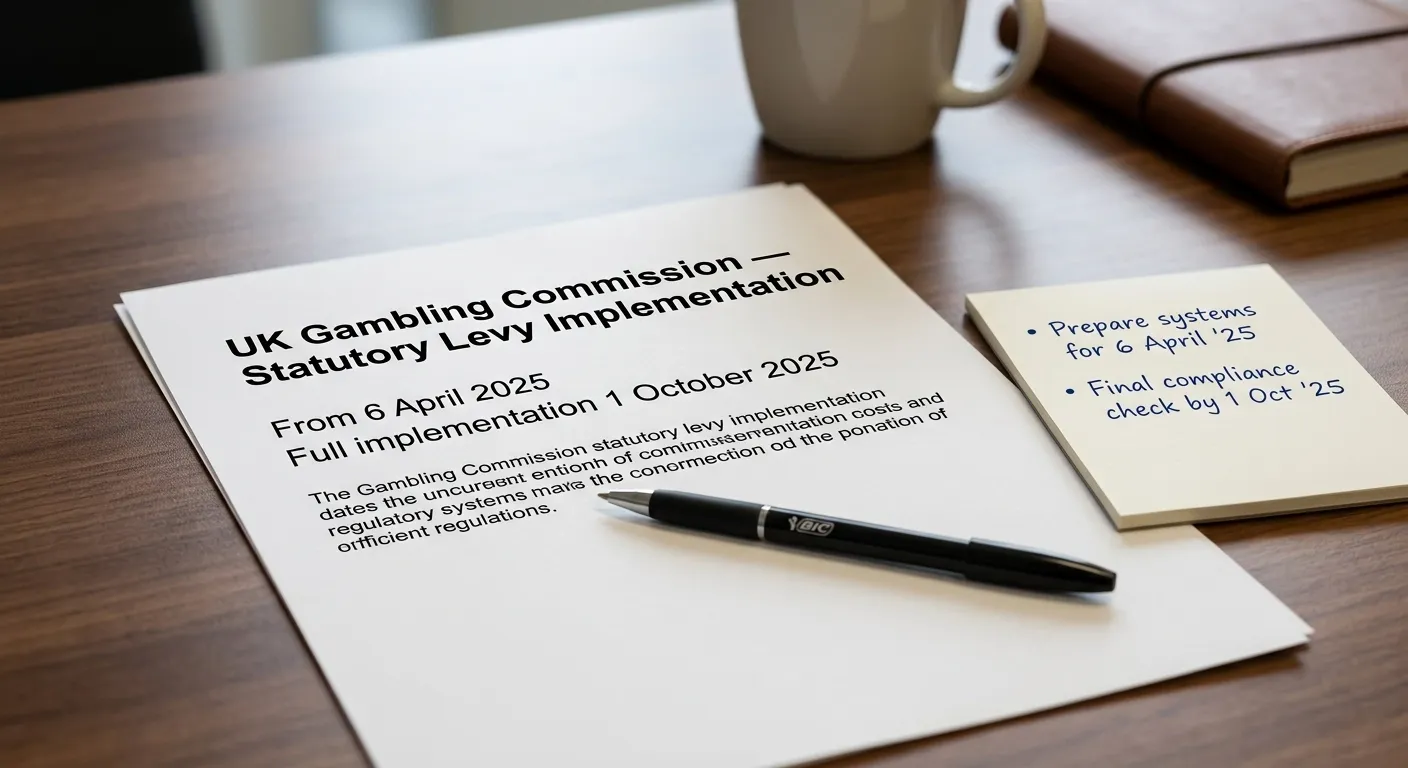
From 6 April 2025, a statutory gambling levy took effect across all Gambling Commission-licensed operators, with full implementation from 1 October 2025. The levy is paid by operators as a share of gross gambling yield — not directly by punters — but it represents a structural cost that creates long-term pressure on the promotional economics driving enhanced each-way term offers. Monitoring whether 2026 additional-place totals track below 2025 levels is worth doing as an early indicator of levy-driven margin repair.
The second change is more immediately practical. From 31 October 2025, all licensed UK bookmakers became legally required to offer new customers the opportunity to set a deposit limit before making their first account top-up. This does not constrain existing systematic bettors directly, but it reflects a broader regulatory shift toward expanded consumer protections — in an environment where the Commission has simultaneously been explicit that it cannot and will not interfere with operators' commercial right to restrict accounts.
The practical implication: the UK regulatory environment in 2026 is more formalised than three years ago. Document your activity. If you believe a restriction has been applied unfairly, the formal complaints route through the bookmaker and then the Independent Betting Adjudication Service remains available — though the Commission's stated position on commercial restrictions means regulatory escalation above that level is unlikely to produce results.
Realistic ROI Expectations: What the Data Says About Long-Term Golf Betting Profitability
The most important number in Steve Palmer's 2025 record is not the 10.81% ROI — remarkable as that figure is over 1,376 bets. It's the 13 winners. Thirteen outright winners from 1,376 attempts is a strike rate of 0.94%. That is what profitable golf betting actually looks like: nearly a thousand consecutive bets without a win interrupted by occasional, expensive hits that carry the year's profit on their own. Three of those winners came at 40/1. The 66/1 and 60/1 winners together contributed more profit to that year's total than an entire quarter of smaller-priced selections.
10.81% — ROI documented across 1,376 golf outright bets in a single professional bettor's 2025 record. Most profitable systematic golf bettors target 5–12% ROI as the realistic long-term ceiling. Anything above 15% over 500+ bets warrants serious scrutiny of whether the sample is genuinely representative.

For a systematic bettor starting out, the honest expectation horizon is a full season minimum before your ROI number is statistically meaningful. At five to ten each-way selections per weekly event, that produces 250 to 520 bets over a year. At that sample size, a skilled system with genuine edge should be showing positive returns — but the early stage is calibration, not profit confirmation. You're learning which of your selection variables have real predictive power, and which feel insightful but produce no edge in the data.
A responsible long-term target for a well-constructed UK golf each-way system is 5–10% ROI over 500+ bets. Below 5% becomes vulnerable to being erased by account restrictions and each-way term changes. Above 15% over large samples almost always involves either exceptional skill in a niche market or a statistical anomaly that hasn't yet mean-reverted. Plan for 5–10% and treat anything higher as a bonus, not a planning assumption.
Golf Betting Systems: Common Questions Answered
What is a golf betting system and how does it differ from a strategy?
A strategy is any practice that improves your chances on a given selection — backing players with strong SG:Approach numbers is a strategy. A system is more comprehensive: it specifies selection criteria, staking rules, market choice, bookmaker management, and record-keeping as an integrated whole. The critical difference is testability. A strategy gives you a direction on individual bets. A system generates a consistent data record you can honestly evaluate, separating skill from luck over time.
Why are each-way bets the foundation of most successful UK golf betting systems?
Because UK bookmakers have developed enhanced place terms — extended place counts reaching 10 or 12 positions — that fundamentally change expected return on long-priced selections. At 10-place terms, a player at 50/1 roughly doubles their probability of triggering the place payout compared to 5-place terms. The place return per occurrence is identical, but the expected frequency doubles. No other major betting sport offers this degree of bookmaker-by-bookmaker variation on a week-by-week basis, and exploiting it systematically requires tracking rather than intuition.
How do strokes gained statistics work and how should you use them when betting on golf?
Strokes gained measures a player's performance in each game component — driving, approach, short game, putting — relative to the Tour average, making the metric course-difficulty neutral. SG:Approach is the single most predictive category for outright contenders on parkland courses. SG:Putting is consistently the least predictive for winners — none of the five most recent Masters winners ranked inside the top 10 in SG:Putting within their field. Use a 24-round rolling window as your baseline to get stable signal rather than noise from short hot runs.
What is the biggest mistake UK golf bettors make when building their first system?
Treating the selection process as the entire system. Bettors spend enormous effort identifying which players to back and virtually none on staking rules, account management, or record-keeping. The result: correct selections that can't access best-value markets because accounts get restricted, can't survive normal variance because stakes are too high relative to bank, and can't be honestly evaluated because records are incomplete. Build all four components — selection, each-way structure, account management, bankroll rules — from the start. The structural components are much harder to retrofit than the selection method.
What bankroll size do you need to run a golf betting system long-term?
For a system based on 25/1–80/1 each-way selections, a minimum of 100 points — where one point equals your standard unit stake — is the operational floor. At 150 points, a drawdown of 30–40 consecutive losing bets leaves you above 60% of starting bank at 2% stakes, the psychological threshold where most bettors stay disciplined. Below 100 points, normal variance runs can destroy bank confidence before you've produced a statistically meaningful sample.
Are UK golf betting systems genuinely profitable in the long run?
Yes — for systems with genuine analytical edge, disciplined staking, and robust account management. A documented ROI of 10.81% across 1,376 bets demonstrates what the upper range looks like; realistic targets for a well-constructed system are 5–10% ROI over 500+ bets. The caveats are real: account restrictions erode returns, each-way terms can be reduced, and results below 200 bets carry no statistical significance. Profitability requires all four system components working together over a patient time horizon.
What is course fit and how do you analyse a player's suitability for a track?
Course fit is the match between a player's documented skill profile and the specific demands of a given golf course. Analyse it in four steps: classify the course by its primary demand (long-drive, precision approach, links wind management, short-game creativity); identify which SG categories correlate with that demand; filter candidates who rank in the top quartile for those categories over a 24-round window; then apply course history as a supplementary filter — particularly at venues like Augusta National, where historical performance is more predictive than at almost any other PGA Tour event.
Four Components, One Decision: Where to Start Your System Build
Every durable golf betting system I've studied — and the one I've run myself over nine years — collapses down to four interdependent components: a data-led selection method, an each-way structure that extracts place term value, a bookmaker account management protocol, and bankroll rules that protect you through variance. The most common failure mode is treating these as separate concerns. They aren't. A selection method without account management eventually loses access to the markets where it finds edge. A bank without staking rules can't survive the drawdowns that any long-priced golf system will encounter. The components only work as a system when they're built together.
If you're starting from scratch: begin with your record-keeping infrastructure before your first bet. Decide on your staking unit, your starting bank in points, your maximum stake per bet as a percentage, and your bookmaker rotation plan. Then identify your primary selection filter — whether SG-based, course-fit-based, or a combination. Then track which bookmakers offer the best each-way terms on each event type. Your first 100 bets are calibration data, not profit data. Treat them accordingly.

The five cluster guides linked throughout this page — on each-way systems, strokes gained, bankroll management, bookmaker selection, and course fit — cover each component in the granular operational detail that this overview can't provide. That's where the system build actually happens. This is the map. The guides are the territory.
