
Three-Ball Golf Betting Strategy: Building a Systematic Edge in Head-to-Head Group Markets
 Available in US
Three-ball markets were the first place I ever found a genuine, repeatable edge in golf betting. Not because they’re easier to beat than outrights—they’re not—but because the structural dynamics that create mispricing are easier to identify once you understand what you’re actually looking for. In an outright field of 156 players, the noise overwhelms everything unless your analytical process is airtight. In a three-ball market, you’re comparing three players over 18 holes. The analysis is narrower, the mispricing more specific, and the market’s systematic weaknesses more visible.
The UK bookmakers price three-ball markets primarily from outright odds and recent form data, with minimal adjustment for the specific characteristics of within-group performance. That’s the gap this strategy is designed to exploit. What follows is how I approach three-ball markets systematically—not as a supplement to outright betting, but as a distinct market with its own logic.
Three-Ball vs. Outright: Why the Market Dynamics Are Fundamentally Different
Here’s something most golf bettors get wrong about three-ball markets: they approach them as miniature outrights. Back the player with the best recent form, or the lowest world ranking, and assume that translates into head-to-head superiority over 18 holes. That’s not how these markets work, and understanding why they don’t is the foundation of building a systematic edge.
In an outright, you’re betting on cumulative performance over 72 holes against a field of 150-plus players. The predictive metrics that matter most—strokes gained totals, course fit scores, SG:APP and SG:OTT averages over 24 rolling rounds—are measuring sustained excellence across a large competitive sample. Variance in any single round is partially absorbed by three more days of play.

A three-ball is a single-round event between three specific competitors. The relevant metrics shift. Per-round variance is everything—a single poor iron approach, a hot putter for 18 holes, or a disruptive playing partner interaction can determine the outcome. The SG:P (strokes gained putting) metric, which I’d largely discount over a four-day tournament, becomes considerably more relevant over a single round because variance in putting is highest per-round and lowest over full tournament samples. A player who putts erratically but whose overall SG average is maintained by exceptional ball-striking can win three-ball after three-ball while frequently missing tournament cuts.
The bookmaker’s pricing model doesn’t account for this with any granularity. Prices are anchored to outright market percentages with overround layered on top. The structural overround in UK three-ball markets typically sits between 108% and 112%—higher than most outright markets, which limits the value available. But within that margin, the individual player pricing is frequently off in ways that a player-versus-player analysis reveals quickly. A player ranked 45th in the world with flat recent form is often priced identically to a player ranked 60th who has posted elite SG:APP numbers over the prior six rounds. Those players are not the same proposition in a head-to-head over 18 holes.
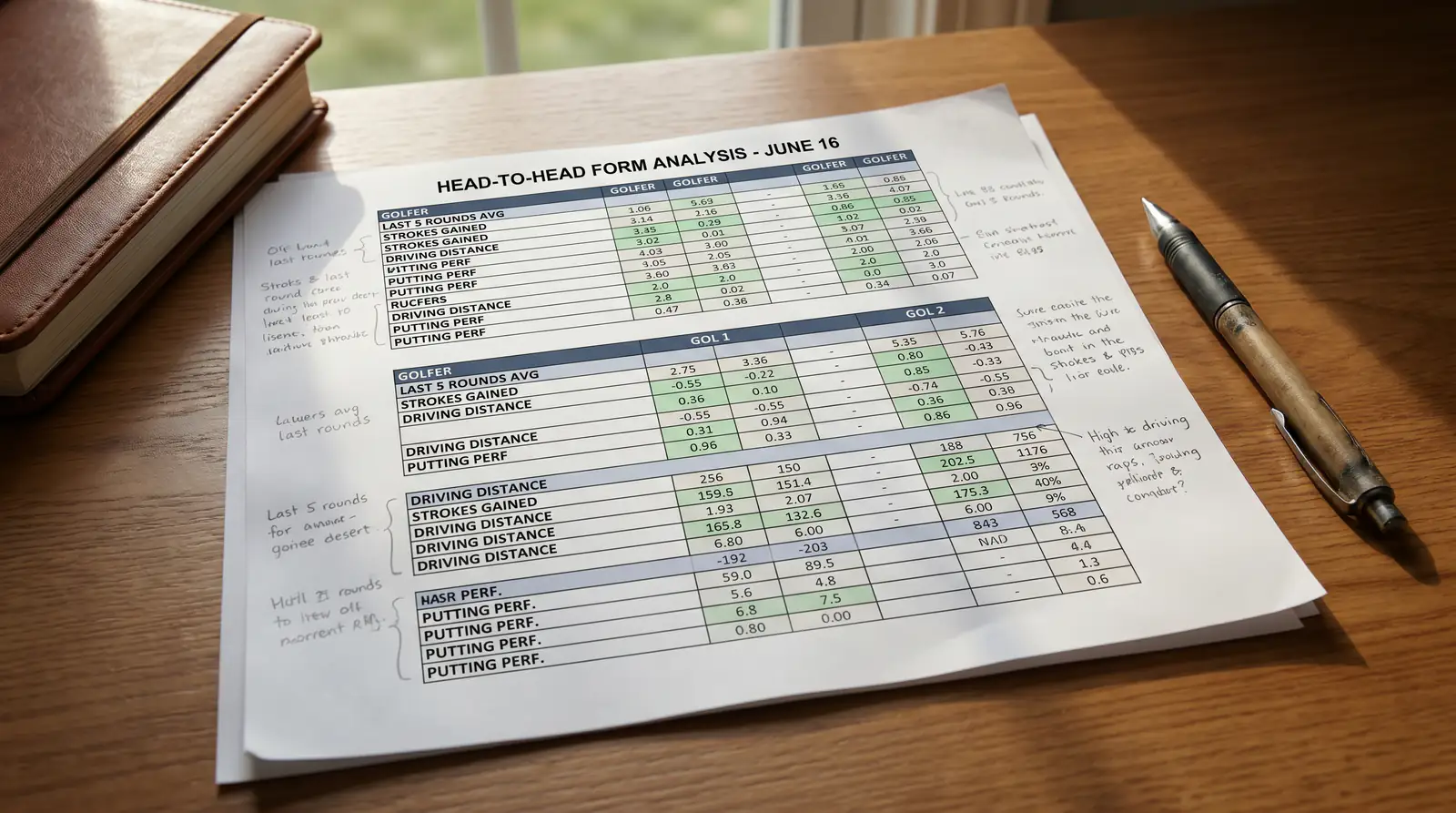
The other dynamic that makes three-ball markets structurally different is draw composition. In outright betting, the draw is irrelevant over 72 holes. In three-ball betting, the pairing you’re in determines your immediate competitive reference group. A player with strong wind-game credentials in a morning draw with exposed links conditions has a different expected value profile than the same player in a calm afternoon draw. UK bookmakers rarely adjust three-ball prices for draw conditions beyond the most obvious tee-time weather discrepancies.
The practical implication: a three-ball analysis needs to be built from the ground up, not derived from outright analysis. I maintain separate three-ball data files for each tour event, tracking per-round SG categories rather than cumulative tournament figures. The 24-round rolling SG average I use for outright analysis is adjusted to a 6-round rolling window for three-ball, which captures recent form more accurately for the single-round context.
Accounting for Draw Probability in Three-Ball Systems
The draw—the dead heat outcome where two or more players in a three-ball tie at the end of 18 holes—is the most systematically underpriced outcome in these markets. Most bettors ignore it. Most bookmakers price it generically. And because the actual draw probability in professional golf is non-trivial at approximately 8-12% per three-ball depending on course and conditions, ignoring it introduces a persistent pricing error.
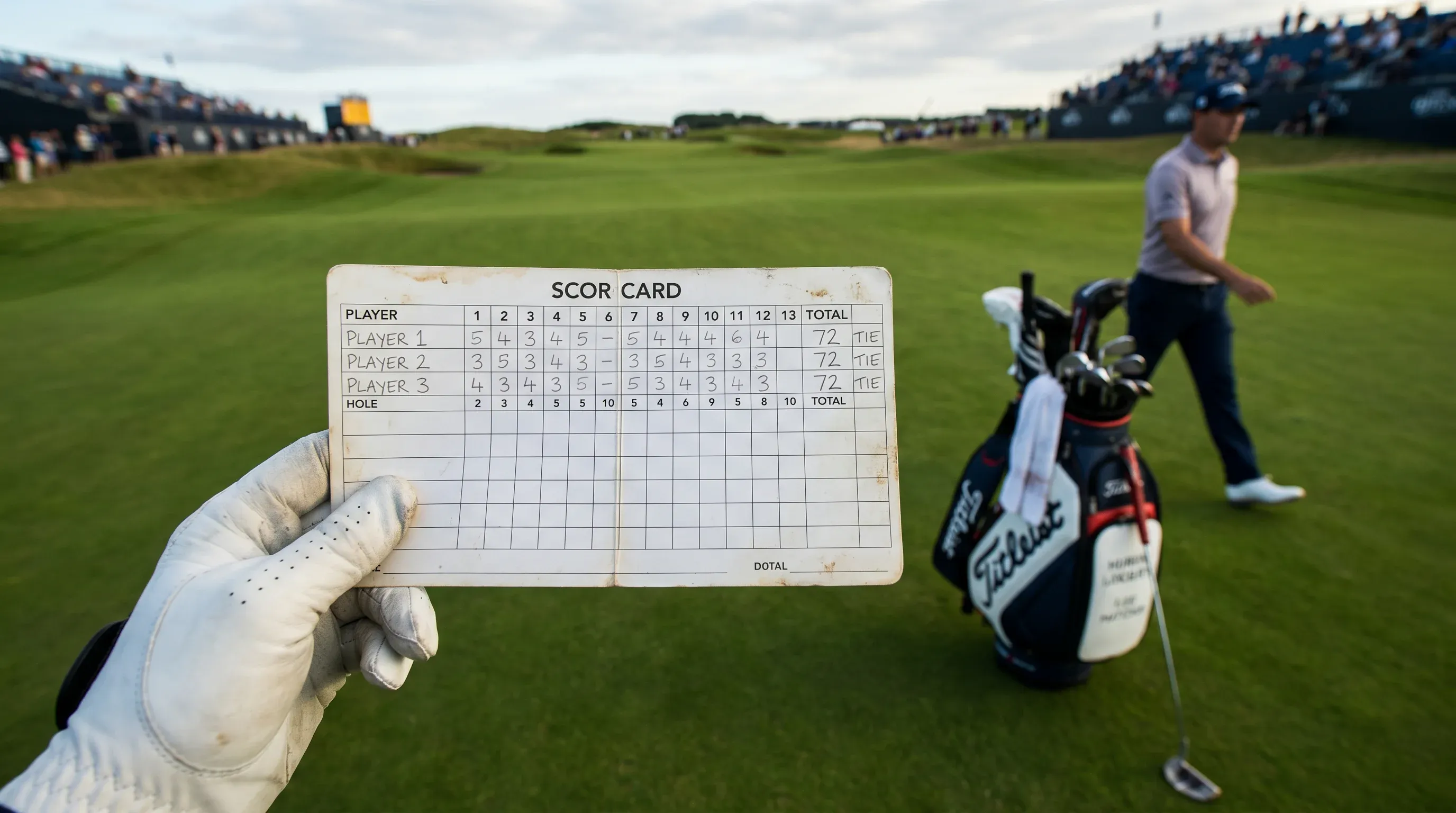
Here’s why draws matter systemically. In a three-ball where the dominant player is priced at 4/6, the second player at 9/4, and the third at 7/2, the implied probability across the three win outcomes adds to roughly 108-110% including overround. But those prices assume the draw is absorbed within each player’s implied probability—which is only valid if the draw is being priced explicitly somewhere. In most UK bookmaker three-ball markets, the draw is listed as a fourth option at long prices like 14/1 or 18/1. If the actual draw probability is 10%, and the market is pricing it at 5-6%, that represents a structural edge on the draw that compounds over a season of three-ball betting.

I don’t bet draws as my primary three-ball strategy. The liquidity is thin and the variance is high even when the price is right. But I use draw probability to calibrate the main player prices. If my model says the draw probability in a specific three-ball is 12% and the market has priced the favourite at 8/13, I need to assess whether that favourite price has properly absorbed the elevated draw risk. Often it hasn’t. The favourite is priced as if one of the other two players will definitively lose, when in reality a 12% draw probability is a meaningful drag on the favourite’s effective win chance.
Tee time grouping also interacts with draw probability in ways the market doesn’t price efficiently. Early-morning tee times on links courses with consistent wind conditions tend to produce tighter scoring distributions than afternoon draws with gusty, variable conditions. A three-ball in a calm morning draw has, in my data, lower average scoring spread between players than one in a difficult afternoon draw—which translates into modestly higher draw probability. When I see a three-ball in calm morning conditions where all three players have similar recent SG form, I adjust draw probability upward by approximately 3-4 percentage points versus my base rate.
Using Strokes Gained in Three-Ball Selection
The strokes gained framework applies to three-ball analysis, but with different category weights than you’d use for outright selection. Nine years of tracking three-ball performance data has produced a consistent pattern: SG:APP (approach) and SG:ARG (around the green) are the strongest predictors of single-round head-to-head performance, while SG:OTT (off the tee) and SG:P (putting) show higher variance and lower predictive power at the individual round level.
This makes intuitive sense. Approach play is the most stable strokes-gained category on a round-by-round basis—elite iron players consistently generate approach advantage, whereas putting can swing dramatically in both directions within 18 holes. A player who ranks in the top 20% of the tour for SG:APP over rolling 24 rounds will maintain that advantage in a single-round three-ball far more reliably than a player whose edge comes from exceptional putting form.

My three-ball SG model weights categories as follows: SG:APP at 40%, SG:ARG at 25%, SG:OTT at 20%, SG:P at 15%. This is calibrated against historical three-ball outcomes from 2021 to 2026 across PGA Tour events with available data. The weighting reduces reliance on putting, which is the category most bookmakers’ models over-weight because it’s the most visible and most discussed by golf media. When a player is described as “putting brilliantly this week,” the bookmaker’s three-ball price often reflects that narrative more than the underlying probability warrants.
One practical application: when my three-ball SG analysis identifies a strong selection but the player has posted poor SG:P numbers in the prior three rounds, I reduce my confidence rating by approximately one tier. The player’s underlying ball-striking edge is real, but elevated putting variance in a single-round three-ball increases the probability of an unexpected outcome. I don’t abandon the selection—the edge is still there—but I size the stake conservatively and consider a small draw-option hedge if the market price supports it.
Three-Ball Golf Betting: Your Questions
How are dead heats handled in three-ball golf betting?
If two or more players in a three-ball tie at the end of 18 holes, dead heat rules apply. Your returns are divided by the number of players sharing the position. For example, if you back a player who ties with one other competitor at 5/2, your winnings are halved -- you effectively receive 5/4. If all three players tie, returns are divided by three. This is why draw probability matters in three-ball staking: a player priced at 4/6 who ties 50% of their apparent wins produces far lower returns than the headline price suggests.
Can you bet three-ball markets in-play on UK bookmakers?
Most major UK bookmakers including bet365, Paddy Power, and William Hill offer in-play three-ball markets during the round, typically suspending for shots and resuming between holes. In-play three-ball betting requires live SG tracking or access to shot-by-shot data, which is not freely available for all tours. Without reliable live data, in-play three-ball is speculative rather than systematic -- the edge you identified pre-round erodes rapidly when you're reacting to leaderboard positions rather than underlying performance metrics.
Does tee time grouping affect three-ball selection?
Yes, significantly. Players in the same draw time face identical course and weather conditions, making the three-ball a purer test of comparative skill than tournament conditions allow. However, where the tee time falls within the day's draw matters for weather exposure on links courses. Morning draws tend to produce tighter scoring spreads on links in variable wind, which increases draw probability and should be factored into your staking. I adjust draw probability upward by 3-4 percentage points for calm-condition morning draws on exposed links venues.
Golf Betting Guides
Ryder Cup Betting System UK: How Match Play Format Rewrites the Rules for Golf Bettors
I've bet every Ryder Cup since 2014. My record through 2023 was erratic in a way that puzzled me until…
Golf Betting Driving Distance Stats: When Power Off the Tee Creates a Systematic Edge
There's a version of the "power advantage" argument in golf that gets recycled endlessly in betting previews — "this course…
Each Way Extra Golf Explained: How to Decide When the Enhanced Terms Are Worth Taking
In 2025, bet365 offered 563 additional each-way places across golf events through their Each Way Extra feature. That's not a…
LIV Golf Betting UK: How the Breakaway Circuit Affects Established Golf Betting Systems
LIV Golf created more analytical confusion for me than any single development in golf betting over my nine years in…
