
Each Way Extra Golf Explained: How to Decide When the Enhanced Terms Are Worth Taking
 Available in US
In 2025, bet365 offered 563 additional each-way places across golf events through their Each Way Extra feature. That’s not a small number — it represents a genuine structural advantage over standard terms if you know when to activate it. The problem is that most bettors use EW Extra as a default rather than a decision, which means they leave money on the table in some situations and pay an invisible price in others.
This article is about the decision framework, not the mechanics of how EW Extra works in general — if you want the full picture on where each-way terms are best across bookmakers, the golf betting each way bookmakers guide covers that in detail. Here, I want to focus on the specific question of whether to take enhanced terms when they’re offered, and how to calculate whether the extra places are worth the trade-off involved.
How Each Way Extra Works: The Mechanics You Need Before the Decision
Each Way Extra and similar features — most notably BoyleSports’ Pick Your Place — allow you to increase the number of each-way places beyond the bookmaker’s standard terms in exchange for a reduction in the place odds fraction. The standard bet365 EW terms for a large PGA Tour field might be 1/5 for eight places. With EW Extra activated, you might get 12 or 14 places, but the fraction drops to 1/8 or 1/10.

Bet365 set a record in 2025 with those 563 additional places, having previously offered 555 additional places in 2024 — the first year they surpassed BoyleSports in this metric. BoyleSports came back in the overall 2025 standings through Pick Your Place, which offers six, ten, or twelve places at 1/5 odds at Majors, giving punters genuine flexibility over how many places to take and at what price. The distinction matters: BoyleSports’ approach preserves the 1/5 fraction regardless of how many places you select, whereas EW Extra typically requires you to accept a lower fraction in exchange for the additional places.

The key mechanical point is this: EW Extra is always two separate bets — the win bet and the place bet — and only the place component changes when you activate enhanced terms. The win portion of your stake is unaffected. So if you back a player each-way at 50/1 for £5 EW (total £10 outlay), and you activate EW Extra to move from eight places to twelve at 1/10 odds rather than 1/5, your win return is identical. The only question is whether the extra places at the lower fraction beat the standard terms mathematically.
The Decision Framework: When to Take Enhanced Terms and When to Decline
The decision hinges on your honest assessment of the player’s finishing probability distribution. Specifically: what is the probability that your selection finishes between position 9 and the maximum enhanced position, and is that probability worth the cost of a lower place fraction on positions 1 through 8?
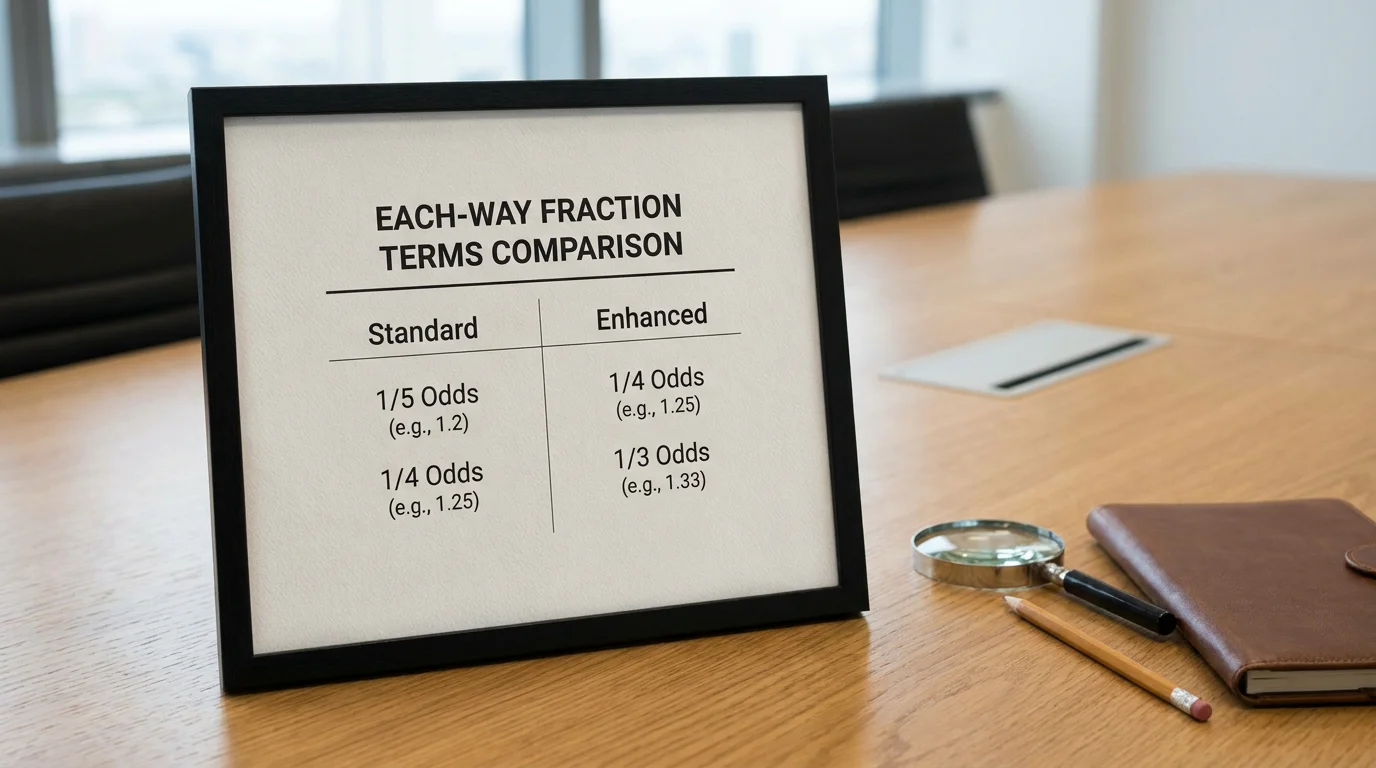
Consider a concrete example. Standard terms: 8 places at 1/5. Enhanced terms: 14 places at 1/8. You’re backing a 66/1 shot. At 1/5, the place return on a finishing position of 2nd through 8th is 66 divided by 5 plus 1 = 14.2. At 1/8, the same finishing positions pay 66 divided by 8 plus 1 = 9.25. The gap between those two returns is roughly 5 points per unit for any finishing position in the top 8. To compensate for that reduction across all likely top-8 finishes, the extra places (9th through 14th) need to have enough combined probability to offset the cost. If you estimate the player has roughly a 4% chance of finishing 9th through 14th and a 5% chance of finishing top 8, the breakeven point for the enhanced terms is when the extra-place probability exceeds roughly half the base-place probability. In this scenario it’s close — worth checking the precise numbers before committing.

The shortcut heuristic I use: enhanced terms are most valuable for mid-price selections (20/1 to 60/1) where the player has a realistic but not dominant chance of finishing in the standard place range. At these prices, the place fraction reduction costs less in absolute terms and the extra places are more likely to be reached. For very short-priced selections (sub 12/1), where finishing in the top places is the most likely paid outcome, you generally want to preserve the higher fraction — giving up 1/5 for 1/10 is expensive when a significant portion of expected value comes from frequent top-8 finishes. For very long-priced selections (80/1 and above), the probability of reaching even the standard places is low enough that the extra coverage from enhanced terms often isn’t worth the fraction cost.
One more factor: field size. In a 78-player event, 14 places covers nearly 18% of the field — that’s generous, and enhanced terms are typically worth taking because the incremental positions represent meaningful probability. In a 156-player event, moving from 8 to 14 places still only covers 9% of the field. The absolute benefit is lower, and the calculation tightens accordingly.
Pick Your Place Separately: How BoyleSports’ Approach Changes the Maths
BoyleSports’ Pick Your Place feature operates on a fundamentally different logic from EW Extra. Rather than trading fraction for places, it allows you to choose how many places you want — up to twelve at Major events — while preserving the standard 1/5 fraction. The cost is implicit rather than explicit: the fact that you’re choosing more places doesn’t cost you a fraction reduction, but it does mean you’re getting standard odds applied to a larger number of finishing positions rather than an enhanced price for the standard range.
In practice, Pick Your Place at 1/5 for twelve positions at a Major is an excellent offer for long-priced outright bets. Twelve places in a 156-player field covers nearly 8% of runners at full 1/5 odds — and at Major events where bookmakers are competing aggressively for market share, those terms represent genuine structural value. The question isn’t whether to use Pick Your Place in these scenarios; it’s whether to use BoyleSports over a competitor offering enhanced terms via a different mechanism.

The comparison to make is always the net expected return for a specific player at a specific price, not a generalised preference for one bookmaker’s feature over another. Calculate the expected place return under each set of terms given your probability estimates for each finishing band, and take the terms that produce the higher figure. Running this calculation once a week as part of your pre-tournament process adds a small but consistent edge that compounds over a season of betting.
Frequently Asked Questions
Does activating EW Extra reduce the place odds fraction?
Yes, in most implementations. Each Way Extra at bet365 and similar features at other bookmakers typically offer additional places in exchange for a lower fraction -- for example, moving from 1/5 odds for 8 places to 1/8 odds for 12 places. The win portion of your bet is unaffected. BoyleSports' Pick Your Place is different: it allows you to select more places while preserving the 1/5 fraction, making the trade-off implicit rather than explicit. Always check the specific terms being offered before accepting, as the fraction reduction varies by event and bookmaker.
Is Each Way Extra available for all golf events?
No -- availability varies by bookmaker and event. Bet365 typically offers EW Extra for the larger PGA Tour events, Majors, and Rolex Series events, but not necessarily for every co-sanctioned event or smaller DP World Tour tournaments. BoyleSports' Pick Your Place availability at the maximum 12-place option is specifically confirmed for Major championships. For mid-tier events, enhanced terms may be available at a lower maximum number of places or not offered at all. Always check the event-specific terms rather than assuming any week's offer matches a previous week.
How do you calculate EV for an EW Extra bet?
Calculate win EV and place EV separately, then combine them. For the win portion, the calculation is unchanged from a standard bet. For the place portion under enhanced terms, you need your estimated probability for each finishing band: the standard place positions (e.g., 1st-8th) and the additional positions (e.g., 9th-14th). Multiply each band's probability by the applicable return, sum them, subtract 1 (your stake equivalent), and compare the result against the same calculation under standard terms. If enhanced terms produce a higher combined EV, take them. If standard terms produce a higher EV -- which can happen when the fraction reduction is large relative to the extra-place probability -- stick with the standard offer.
Golf Betting Guides
Golf Betting Driving Distance Stats: When Power Off the Tee Creates a Systematic Edge
There's a version of the "power advantage" argument in golf that gets recycled endlessly in betting previews — "this course…
Golf Betting Record Keeping UK: The Data You Must Track to Evaluate Your System Honestly
Most bettors know their wins better than they know their results. Ask someone who follows golf seriously how they're doing…
Golf Betting Systems That Work in the UK: What Evidence-Based Selection Actually Looks Like
I've read a lot of claims about golf betting systems over the years. Most of them are backed by nothing…
PGA Tour Betting Tips UK: How to Approach the World’s Deepest Golf Betting Market
The PGA Tour is, by a significant margin, the deepest and most efficiently priced golf betting market in the world.…
