
Using DataGolf for Golf Betting: How the Model Works and Where It Finds Bookmaker Mispricing
 Available in US
DataGolf has become, in a relatively short time, the most cited analytical tool in serious golf betting discussion—and for good reason. The platform provides the most rigorous publicly available predictive model for professional golf, with explicitly stated methodology, ongoing model transparency, and the kind of long-term probability comparison to bookmaker prices that allows an informed bettor to assess where the genuine gaps lie. I’ve used DataGolf as part of my analytical process for several years, and I want to give an honest account of what it actually provides, what it costs, and where its outputs are most and least reliable for UK betting purposes.
How DataGolf’s Prediction Model Works: Inputs, Weights, and Output Probabilities
DataGolf’s predictive model is built on a player skill rating system that integrates strokes gained data across multiple tours, weighted by recency and field quality. The core inputs are: each player’s SG performance across all measured events in the prior 24 months, adjusted for the strength of the fields they competed against; a course-specific adjustment based on historical performance at the specific venue; a fit score that matches player SG profiles to the course’s measured characteristics; and, for in-tournament predictions, the current state of play.
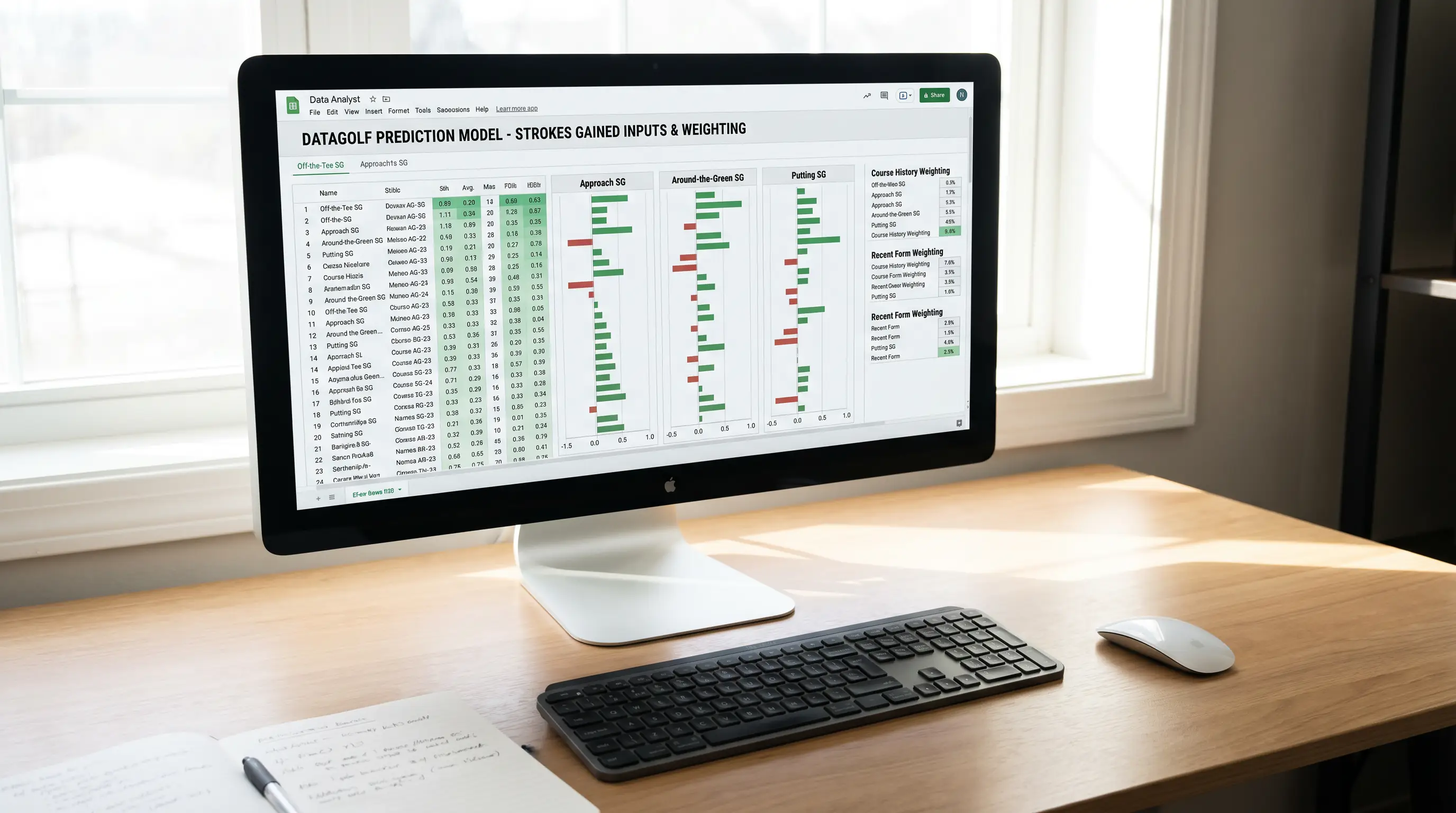
Matt Courchene, DataGolf’s co-founder, described the model’s evolution in a 2025 interview: “Continuous comparison of our probabilities to the betting market exposed model defects, leading to improvements: accounting for weather forecasts by tee time, adjusting player skill when leading, adding home nation effects.” This ongoing calibration against the betting market is one of DataGolf’s most valuable methodological characteristics—the model has been refined by thousands of real-world comparisons against bookmaker prices, which surfaces systematic errors that pure historical data analysis wouldn’t reveal.

The output is a probability distribution across all field members for each finishing position—win probability, top-5, top-10, top-20, make-cut, and so on. These probabilities are then directly compared to implied probabilities from bookmaker odds to identify where DataGolf’s model suggests meaningful mispricing. A player with a DataGolf win probability of 8% priced at 20/1 (implied probability approximately 4.7%) represents a model-versus-market gap of over 3 percentage points—which, in DataGolf’s framework, represents a potentially positive expected value position.
Courchene has also noted the platform’s relationship with US betting markets: “When sports betting was legalised in the US in 2018, this provided us with a natural business model.” The DataGolf subscription service emerged from this commercial context, which is worth understanding—the paid model is designed partly for sophisticated bettors who want to use it as a systematic tool, not just for golf fans who want to understand performance analytics. The tool design reflects that audience.
DataGolf Probabilities vs. Bookmaker Prices: Finding the Systematic Gaps
The most practically useful feature DataGolf provides for systematic bettors is the direct comparison between model probabilities and bookmaker odds. The platform displays these comparisons in real time (with some update lag) across the major markets. But understanding where to trust these gaps—and where to be sceptical of them—is essential before using them as a betting signal.
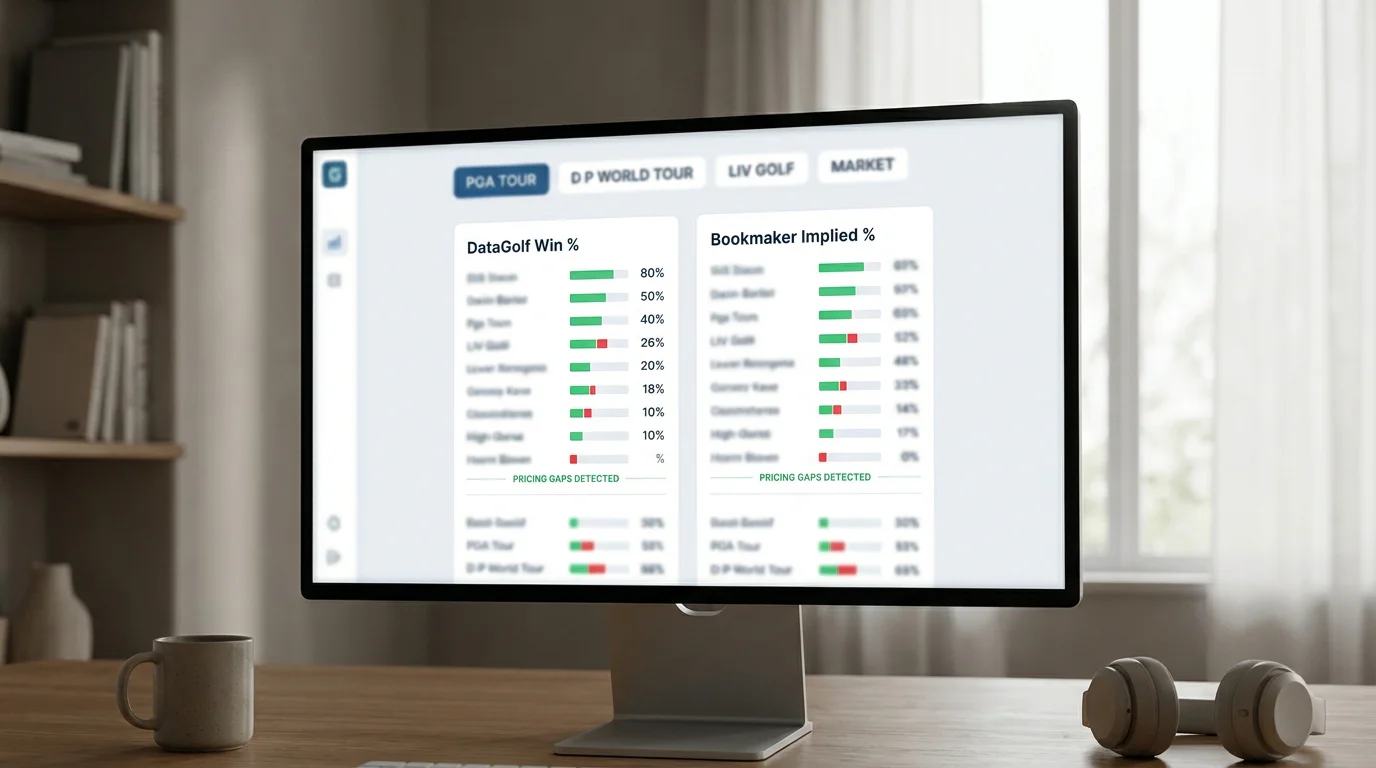
DataGolf’s model is most reliable for PGA Tour events at established venues with multiple seasons of ShotLink data available. In these conditions, the model’s probability estimates are built on a dense data foundation and the comparison to bookmaker prices is the most meaningful. The gap between DataGolf’s implied probability and the bookmaker’s implied probability is most likely to reflect genuine mispricing when: the player in question has 20+ rounds of ShotLink data at the specific venue or comparable venue type; the model has a positive history of finding edge at similar price ranges; and the market is not an early-week speculative price that will be refined before the event.

The model is least reliable for: DP World Tour events where SG data coverage is incomplete; courses making their debut on the tour without historical comparison data; and players who have recently undergone significant form changes (injury recovery, swing restructuring) that the model hasn’t yet fully incorporated. In these cases, treating DataGolf’s probability estimates as indicative rather than authoritative is the appropriate calibration.
One pattern worth noting from my usage: DataGolf tends to underweight course history for Augusta National specifically and the Masters more broadly. The platform’s own data suggests Augusta course history matters more than at any other PGA Tour venue, but the model’s primary weighting on recent SG data means long-term Augusta specialists don’t always receive full credit for their course-specific advantage. This is a known characteristic of SG-weighted models that are calibrated on all-tour data rather than venue-specific samples.
Accessing DataGolf as a UK Bettor: Free vs. Paid Features
DataGolf operates on a freemium model with genuinely useful free content and more powerful tools behind a subscription wall. The free tier provides access to: current world player rankings (the DataGolf tour-adjusted ranking system), basic tournament field information, and historical event data. This free content is valuable for understanding the comparative skill landscape of any given field without requiring any payment.
The paid subscription—which, as of 2025, runs approximately $20-30 USD per month—provides access to: the live win probability comparison against bookmaker odds; detailed strokes gained breakdowns by category and course type; the predictive model outputs for upcoming events with full probability distributions; and historical model performance data that allows you to assess the model’s track record in specific market types. According to the platform’s own published performance data, DataGolf’s pre-tournament predictions have maintained a consistent positive expected return when betting at prices where the model identifies a 3+ percentage point advantage over bookmaker implied probability.

For UK bettors specifically, the subscription cost needs to be weighed against the practical betting volume and stakes where DataGolf’s edge identification translates into actual return. At stakes of £20-50 per selection with 5-10 selections per week, the subscription cost represents a modest overhead that is recovered if the DataGolf comparison improves even one selection per month. At stakes below £10 per selection, the subscription cost may represent a meaningful portion of the potential edge—at which point using DataGolf’s free tier combined with manual SG analysis from the PGA Tour’s public statistics portal is a more cost-effective approach.
DataGolf for Betting: Questions
Is DataGolf's model free to use for UK golf bettors?
DataGolf provides a free tier with basic functionality including player rankings and historical event data. The features most useful for systematic betting -- live win probability versus bookmaker comparison, detailed SG breakdowns by category and course type, and full probability distributions for upcoming events -- require a paid subscription at approximately $20-30 USD per month. The free tier is sufficient for general player quality assessment; the paid subscription provides the specific tools that allow meaningful model-versus-market gap identification.
How accurate are DataGolf's win probabilities compared to bookmaker odds?
DataGolf's model has demonstrated consistent ability to identify mispriced selections in the 25-100/1 range over multiple seasons of comparison against PGA Tour bookmaker markets. The platform publishes its own performance data showing historical returns when betting at prices where the model shows a meaningful positive gap over bookmaker implied probability. The model is most accurate for PGA Tour events at established venues and least accurate for DP World Tour events with limited SG data coverage, debut venues, or players in significant form transition. Treat DataGolf outputs as a primary analytical input, not an infallible signal.
Does DataGolf provide DP World Tour coverage or only PGA Tour?
DataGolf provides global player ratings that incorporate DP World Tour results, and their predictive model generates probabilities for DP World Tour events. However, the model's precision for European circuit events is lower than for PGA Tour events because the underlying SG data coverage is less comprehensive and the historical depth is shallower. DataGolf explicitly notes that their DP World Tour model outputs should be treated with wider confidence intervals than PGA Tour predictions. For co-sanctioned events where PGA Tour ShotLink data covers part of the field, DataGolf's accuracy improves for the dual-tour players.
Golf Betting Guides
Each Way Extra Golf Explained: How to Decide When the Enhanced Terms Are Worth Taking
In 2025, bet365 offered 563 additional each-way places across golf events through their Each Way Extra feature. That's not a…
Betfair Exchange Golf Betting Strategy: How the Exchange Differs From Bookmaker Systems
My relationship with Betfair Exchange in golf betting has evolved considerably over the years. I started using it primarily as…
Golf Spread Betting UK: How Index Betting Works and When It Beats Fixed-Odds Systems
I came to spread betting in golf late, and honestly, somewhat reluctantly. After years building fixed-odds systems, the idea of…
Golf Betting Putting Stats: Why Strokes Gained Putting Is the Most Misused Metric in Systems
None of the last five Masters winners ranked in the top 10 for strokes gained: putting at Augusta National in…
