
Golf Betting Putting Stats: Why Strokes Gained Putting Is the Most Misused Metric in Systems
 Available in US
None of the last five Masters winners ranked in the top 10 for strokes gained: putting at Augusta National in the year they won. That finding from DataGolf’s 2026 analysis is uncomfortable if you’ve spent any time building a selection model that weights SG: putting heavily. Most punters treat a player on a hot putting streak as a meaningful positive signal. The data suggests the opposite — or at least something far more nuanced than the surface reading allows.
SG: putting is the most visible strokes gained category because putting is the most visible part of golf. A missed six-footer on the 18th green in a major broadcast fills ten seconds of airtime. A poorly struck 4-iron that leaves a 40-foot putt rather than a 15-footer is analytically more damaging but generates no comparable moment. The visibility gap between putting and ball-striking creates a persistent bias in how recreational bettors — and many tipsters — weight the categories in their selection process. It’s a bias worth correcting explicitly.
The SG: Putting Misuse Problem in Golf Betting Systems
The most common form of SG: putting misuse is selecting players who are running hot with the flat stick and expecting that form to carry forward into the next event. On the surface, it’s a logical inference — if someone putted brilliantly last week, they might putt brilliantly again this week. In practice, putting performance regresses toward an individual player’s mean faster than any other strokes gained category, and the mean itself is considerably more compressed than ball-striking means.

Consider the range. The gap between the tour’s best ball-striker and an average ball-striker, measured in SG: off-the-tee and SG: approach combined, can be three to four strokes per round at the extremes. The gap between the tour’s best putter and an average putter is considerably smaller — typically one to 1.5 strokes per round in a good week, and the player who delivers that level of putting performance consistently over 20 or more events per season is genuinely exceptional. Most players oscillate: good putting weeks followed by mediocre putting weeks, with the underlying skill level sitting in a relatively narrow band compared to the other categories.

The second misuse is using SG: putting as a course-fit signal without adjusting for green type and slope. A player who putts well on bentgrass greens may not carry that putting advantage to a course with poa annua or bermuda surfaces. A player who performs well on flat greens at a parkland course may struggle on the severe undulations at Augusta. Treating SG: putting as a generic positive signal ignores the surface-specific reality that different courses produce different variance in putting performance. The metric doesn’t travel as cleanly between venues as SG: approach or SG: off-the-tee does.
Third: course history in putting is unreliable as a predictive signal precisely because putting is so variable. A player who putted brilliantly at Muirfield two years ago was partly benefitting from conditions — firm, receptive bentgrass in a particular week’s weather — that may or may not replicate this year. Compared to SG: approach history at the same course, which reflects genuine skill-to-layout interaction that tends to persist, putting history at a specific venue is a thin signal carrying significant noise.
Putting Regression: How Fast the Hot Hand Fades
The regression rate for putting performance is faster than most betting models account for. Research on SG: putting predictability consistently shows that a player’s putting performance in one four-round event predicts their putting performance in the following event only weakly. The correlation is positive but low — somewhere in the range of 0.15 to 0.25 in most studies that have examined this, compared to 0.5 or higher for ball-striking categories over the same period.

In practical terms, this means that a player who gained 1.5 SG: putting in their last event has a probable expectation of gaining something close to their long-run putting mean in the following event — not 1.5, and not necessarily positive at all. If their long-run mean is plus 0.3 SG: putting, that’s the best estimate for next week, and the single-event deviation of plus 1.5 should be discounted heavily rather than extrapolated forward. The hot hand in putting is mostly illusion — not entirely, because genuine putting skill does exist and is persistent over very long samples, but the week-to-week signal is weak enough that building short-term momentum into a betting model around it adds noise rather than signal.

The faster regression also means that players who putted poorly last week shouldn’t be penalised heavily. A player who lost 1.0 SG: putting last week but whose long-run putting mean is minus 0.1 per round is probably not significantly worse this week than they were before the bad event. If their ball-striking form is intact — which you can verify through SG: approach and SG: OTT — the case for backing them at a price influenced by last week’s poor putting is often stronger, not weaker, than the leaderboard result suggests.
When Putting Stats Actually Matter in Your Selection Process
The corrective to SG: putting overweighting is not to ignore putting entirely. There are specific scenarios where the metric carries genuine predictive relevance, and excluding it completely from a selection framework would be its own analytical error.
The first scenario is greens where putting variance is structurally reduced. On very fast, undulating greens — Augusta being the clearest example — lag putting and green-reading precision create a wider performance gap than on average-speed greens, because the penalty for slightly misread putts is amplified. Players with documented strong SG: putting performance specifically on fast, sloped surfaces — and who have consistently delivered that performance across multiple seasons rather than a single hot week — carry a genuine structural advantage at tracks like Augusta, Muirfield, or Royal Melbourne. The key word is documented and consistent. One or two strong weeks on fast greens is not sufficient evidence.
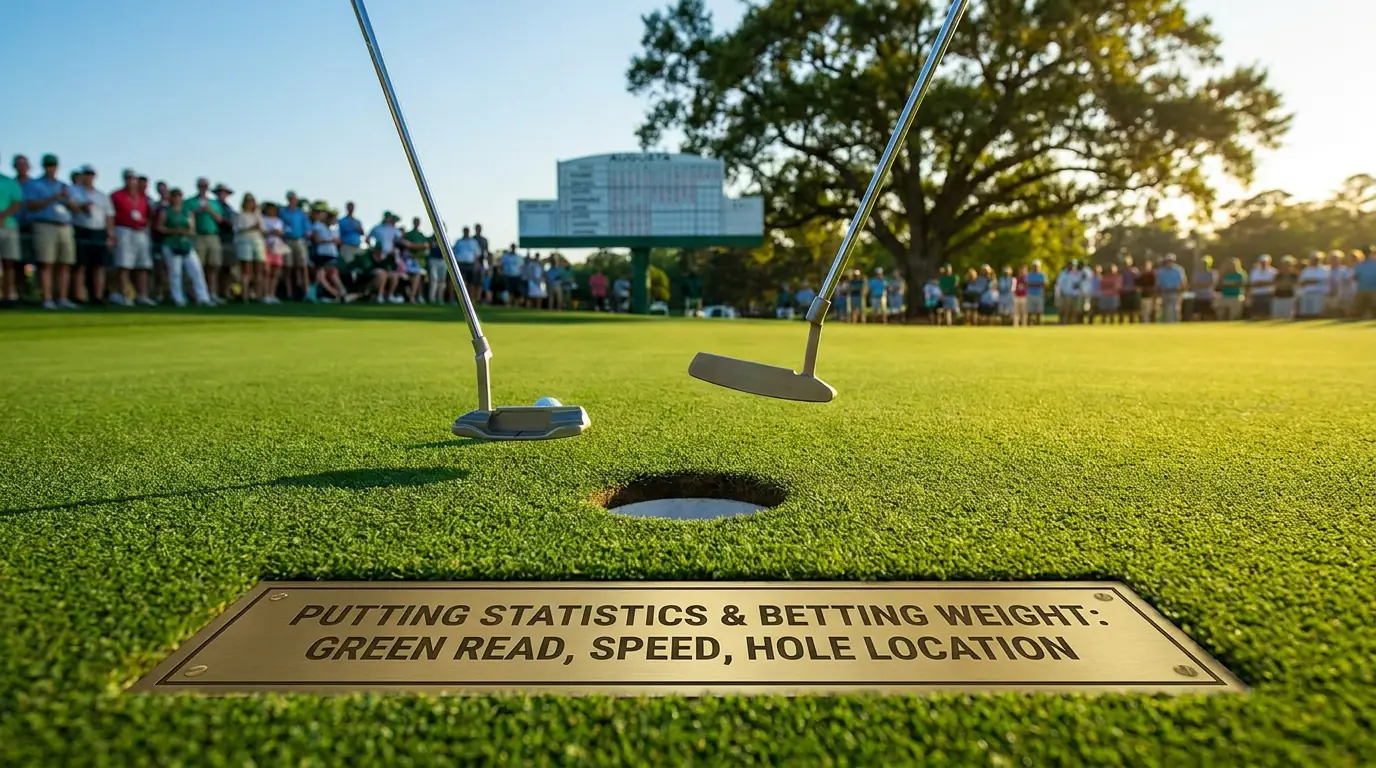
The second scenario is when you’re evaluating a player whose ball-striking profile is strong but whose putting mean is genuinely below average. This matters at the margins: two players with equivalent SG: approach and SG: OTT profiles at a ball-striking-dominant course should be treated as roughly equivalent, but if one is a consistent minus-0.5 SG: putting player and the other is a consistent plus-0.3 player, the long-run putting difference — not last week’s figure, but the career or multi-season mean — is a legitimate differentiator. Use the mean, not the recent sample, and be appropriately sceptical about how much the mean actually predicts across venues and conditions.
The cleaner framing for where putting fits in a selection model: treat SG: approach and SG: OTT as the primary analytical engines. Treat SG: around the green as a secondary check for approach-dominant courses where scrambling proximity matters. Treat SG: putting as a long-run mean adjustment only, not a momentum signal, and reserve it as a differentiator only when two otherwise equivalent candidates are genuinely separated by a persistent multi-season putting differential. That’s a far more conservative use of the metric than most golf betting content recommends — and in this case, the conservatism is well-supported by the evidence.
Frequently Asked Questions
Does SG putting predict Major championship winners?
The evidence suggests it predicts them less reliably than ball-striking categories. DataGolf's analysis of Masters results through 2026 shows that none of the last five winners ranked in the top 10 for SG: putting in the year they won. Across the four Majors collectively, approach play and course management have shown stronger predictive relationships with final leaderboard positions than putting performance. This doesn't mean putting is irrelevant at Majors, but it does mean that a model over-weighted toward putting will tend to underperform a model that prioritises ball-striking and approach categories.
How quickly does putting form regress between events?
Faster than most bettors account for. The week-to-week correlation for SG: putting performance is typically in the range of 0.15 to 0.25 -- meaning a hot putting week explains only a small fraction of the following week's putting performance. By contrast, ball-striking categories show correlations closer to 0.5 over the same period. The practical implication: a player who gained 1.5 SG: putting last week should be modelled closer to their long-run mean for this week, not as a continuation of that hot streak. Downgrade the recent putting figure significantly and substitute the player's multi-season mean wherever available.
Should you exclude SG putting entirely from a golf betting model?
No -- that would introduce its own error. Long-run SG: putting mean, calculated across 60-plus rounds at minimum, captures a genuine skill differential that is persistent even if it regresses within any single event. A player with a career SG: putting mean of plus 0.5 is structurally better on the greens than one with a minus 0.4 mean, and that difference accumulates over a tournament. The distinction is between using the career mean as a steady differentiator -- which is valid -- and using last week's putting hot streak as a momentum signal -- which is not. Keep the long-run mean; discard the short-run extrapolation.
Golf Betting Guides
Golf Betting Odds Comparison UK: How Best-Price Shopping Compounds System Returns
The most underrated skill in systematic golf betting is not finding value selections—it's getting the best available price on the…
Golf Spread Betting UK: How Index Betting Works and When It Beats Fixed-Odds Systems
I came to spread betting in golf late, and honestly, somewhat reluctantly. After years building fixed-odds systems, the idea of…
Golf Betting Value Finder: How to Calculate Expected Value Before Every Systematic Pick
Nine years into this, I still do the same arithmetic before every single outright pick. Not because the maths is…
Three-Ball Golf Betting Strategy: Building a Systematic Edge in Head-to-Head Group Markets
Three-ball markets were the first place I ever found a genuine, repeatable edge in golf betting. Not because they're easier…
