
PGA Tour Betting Tips UK: How to Approach the World’s Deepest Golf Betting Market
 Available in US
The PGA Tour is, by a significant margin, the deepest and most efficiently priced golf betting market in the world. That’s both its greatest asset and its defining challenge for a systematic UK bettor. The depth of the market means liquidity is available at prices from 5/1 to 200/1 with minimal slippage. The efficiency means the bookmaker models are better calibrated here than anywhere else in golf, because the data infrastructure—ShotLink, strokes gained statistics going back 15 years, DataGolf’s predictive model—is more comprehensive on the PGA Tour than on any other circuit.
What this means practically: beating the PGA Tour market requires a higher standard of analysis than beating the DP World Tour market. The low-hanging inefficiencies that exist on the European circuit—limited public SG data, weaker compiler attention to smaller fields—don’t apply to a PGA Tour event at a major American venue on a prime weekend television slot. You’re competing against sophisticated bookmaker models with excellent data. The edge still exists, but you need to know specifically where to look for it.
PGA Tour Market Structure: Why the Depth Creates Both Opportunity and Risk
Golf is the third most popular sport for UK bettors—15% of online bettors placed a golf wager in the past 12 months according to YouGov data—and the PGA Tour accounts for the majority of that volume. The concentration of bettor attention on PGA Tour events creates a market structure where the headline names are very efficiently priced and the mid-field is periodically mispriced.

The most precisely priced portion of any PGA Tour outright market is the top 15-20 players by world ranking. These players receive the most data attention, the most media coverage, and the most bettor volume. Their prices are typically within 2-3 percentage points of the true probability estimates generated by DataGolf’s model—an impressive level of accuracy that leaves minimal systematic edge for a bettor working with the same public data. I rarely find value in the top 15 of any PGA Tour field and have largely stopped analysing them for outright positions.

The mid-field—players ranked between 30th and 100th in the world—is where PGA Tour betting value consistently accumulates. These players receive sufficient public attention that their prices aren’t wildly off, but the compiler models have less granular data integration for them than for the top 20. When a player ranked 55th in the world posts elite SG:APP numbers over 24 rounds at a specific venue type but is priced identically to a player ranked 50th who has shown no particular course-type affinity, the mispricing is real and the edge is there.
Prize fund matters to market depth in a way that’s often underestimated. PGA Tour events with elevated prize funds—Signature Events, Majors, WGC-equivalent events—attract deeper bookmaker modelling resources and tighter overrounds (typically 108-112% vs. 115-120% for smaller events). For a systematic bettor, higher-profile events are not necessarily where the best value lies. The best value-to-analysis ratio I’ve found on the PGA Tour is in the medium-prize-fund events with fields of 120-140 players, where compiler attention is focused and place terms are competitive, but the betting volume is sufficient to support meaningful stakes.
PGA Tour Data Sources for Systematic Betting
The data advantage that any serious PGA Tour betting system requires is primarily strokes gained. The PGA Tour makes ShotLink data available publicly through its statistics portal, providing rolling SG averages in all five categories for every active tour member. This data is updated after each event and represents the single most valuable public resource for PGA Tour betting analysis.

The limitation of PGA Tour’s own statistics portal is granularity. You get rolling averages and seasonal totals, but not the round-by-round SG distributions, course-type adjusted figures, or recency-weighted models that the DataGolf platform provides. For a bettor building a systematic approach without DataGolf access, the public portal is sufficient for identifying the top-level SG profile of each player but lacks the precision needed for competitive market exploitation at the level an experienced analyst requires.

On the data coverage question—PGA Tour vs DP World Tour—the PGA Tour’s advantage is overwhelming. Five categories of publicly available strokes gained data, updated weekly, with ten-plus years of historical depth. DP World Tour data is inconsistently available, with only partial SG coverage through DP World Tour’s own portal and significant gaps in historical depth. This is why my PGA Tour analysis is more systematic and data-driven than my DP World Tour work—the infrastructure supports it in a way that the European circuit simply doesn’t yet.
One data source worth bookmarking for UK bettors specifically: the PGA Tour’s event-by-event course stats pages, which provide venue-specific SG breakdowns for all players who have competed at that course in the prior four years. This course-specific SG data is not aggregated in the standard statistics portal and requires manual access through individual event pages, but it provides the most direct measure of a player’s historical performance on a specific track.
Accessing PGA Tour Markets from UK Bookmakers: Coverage and Timing
One concern I hear frequently from UK-based golf bettors is whether PGA Tour markets are consistently accessible. The answer is yes, for all but a handful of specialist events per season. The main UK bookmakers—bet365, Paddy Power, William Hill, Coral, BoyleSports—offer outright markets for essentially every full-field PGA Tour event. The smaller, limited-field events (limited to 48-60 players, typically invitation-only) have more variable coverage, with bet365 typically offering markets where others don’t.
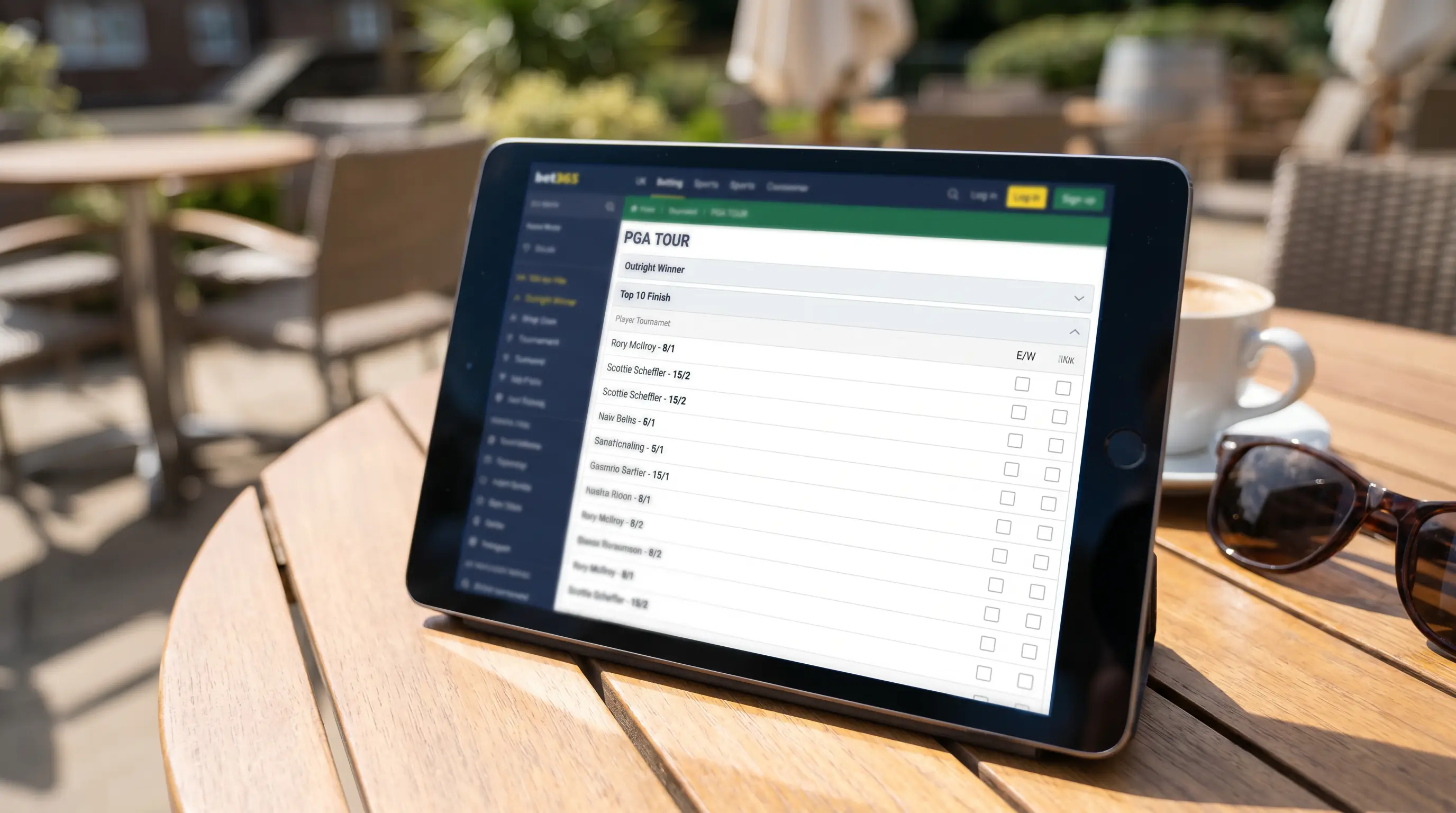
Timing of market opening matters for UK bettors chasing early prices. PGA Tour outright markets typically open on the Monday or Tuesday before the event, seven to ten days ahead of the first round. Early prices on Tuesday morning often represent the rawest version of the bookmaker’s model before public money has shaped them. My practice: check early markets on Tuesday morning, note any prices that diverge significantly from my weekend analysis, and decide whether the gap is large enough to warrant betting before further market movement narrows it.

The practical challenge for UK bettors is time zones. A PGA Tour event that tees off at 12:00 ET on Thursday is starting at 17:00 GMT. The morning draw completes after midnight UK time. For systematic bettors who want to track first-round performance data to inform in-play positions, the time commitment is significant. I largely limit my in-play PGA Tour activity to Saturday and Sunday afternoon GMT, when the final rounds overlap with UK daytime hours and data monitoring is sustainable.
PGA Tour Betting: Questions for UK Bettors
Can UK bettors access PGA Tour markets every week of the season?
Yes, with a small number of exceptions. Full-field PGA Tour events (typically 132-156 players) have outright markets at all major UK bookmakers every week of the main season, roughly September through August. Limited-field events like the Players Championship invitational rounds and WGC events have variable coverage -- bet365 offers markets for most of them, while smaller operators may limit coverage to Majors and Signature Events. The week between Christmas and New Year and the Players Championship field selection period are the most common gaps.
How does PGA Tour prize fund affect the quality of the betting market?
Higher prize funds correlate with tighter overrounds and more precise bookmaker pricing. Signature Events and Majors -- events with $20 million+ prize funds -- attract significantly more compiler attention than a standard $9-12 million event. This means the Signature Event market is typically the most efficient on the PGA Tour calendar, while a standard autumn swing event at a lesser-known venue may have pricing gaps that a systematic approach can identify. For new systematic bettors, starting with mid-tier events offers better risk-adjusted practice than immediately targeting the most competitively priced weeks.
Is PGA Tour data or DP World Tour data better for building betting systems?
PGA Tour data is substantially better for systematic betting model construction. The ShotLink strokes gained database covers five categories across 15+ years of events, is publicly available through the PGA Tour statistics portal, and is updated weekly. DP World Tour data lacks consistent SG coverage, has shorter historical depth, and shows larger gaps for events outside the European mainland. Players competing on both tours are often better analysed using their PGA Tour SG record even for DP World Tour events, which creates opportunities when European tour compilers underweight the most relevant data.
Golf Betting Guides
UK Bookmaker Account Restrictions in Golf Betting: What the Gambling Commission Data Reveals
Account restrictions are the most uncomfortable topic in systematic golf betting, and the most important one to understand clearly. I've…
Golf Betting Driving Distance Stats: When Power Off the Tee Creates a Systematic Edge
There's a version of the "power advantage" argument in golf that gets recycled endlessly in betting previews — "this course…
Golf Betting Record Keeping UK: The Data You Must Track to Evaluate Your System Honestly
Most bettors know their wins better than they know their results. Ask someone who follows golf seriously how they're doing…
Golf Betting Systems That Work in the UK: What Evidence-Based Selection Actually Looks Like
I've read a lot of claims about golf betting systems over the years. Most of them are backed by nothing…
