
Golf Outright Betting Strategy UK: How to Find Value in Winner Markets Without Each-Way Cover
 Available in US
Backing a golf tournament winner outright—no each-way cover, no place insurance, just the winner—is the most honest test of your analytical process. Every systemic error in your model is exposed. When each-way betting forgives a top-10 finish, outright betting doesn’t. It either wins or it loses. This creates a useful discipline: you can’t hide behind “I nearly got it right.” Either your selection analysis was right, or it wasn’t.
I use outright betting as a relatively small proportion of my total golf betting portfolio—roughly 25-30% by capital, with the remainder in each-way positions. But the outright analysis is more rigorous, the price sensitivity more important, and the selection criteria genuinely different from each-way betting. What I want to lay out here is not why to prefer outrights—I don’t, broadly—but how to apply a systematic approach when the outright structure is the right choice for a specific selection.
Outright vs. Each-Way: The Mathematical Comparison That Should Drive Your Decision
The choice between outright and each-way is not a philosophical preference—it’s a mathematical question with a context-specific answer. The answer changes depending on the price, the each-way terms available, and your probability estimate of the player’s outcome distribution. Getting this calculation right week by week is one of the most frequently overlooked edges in golf betting.
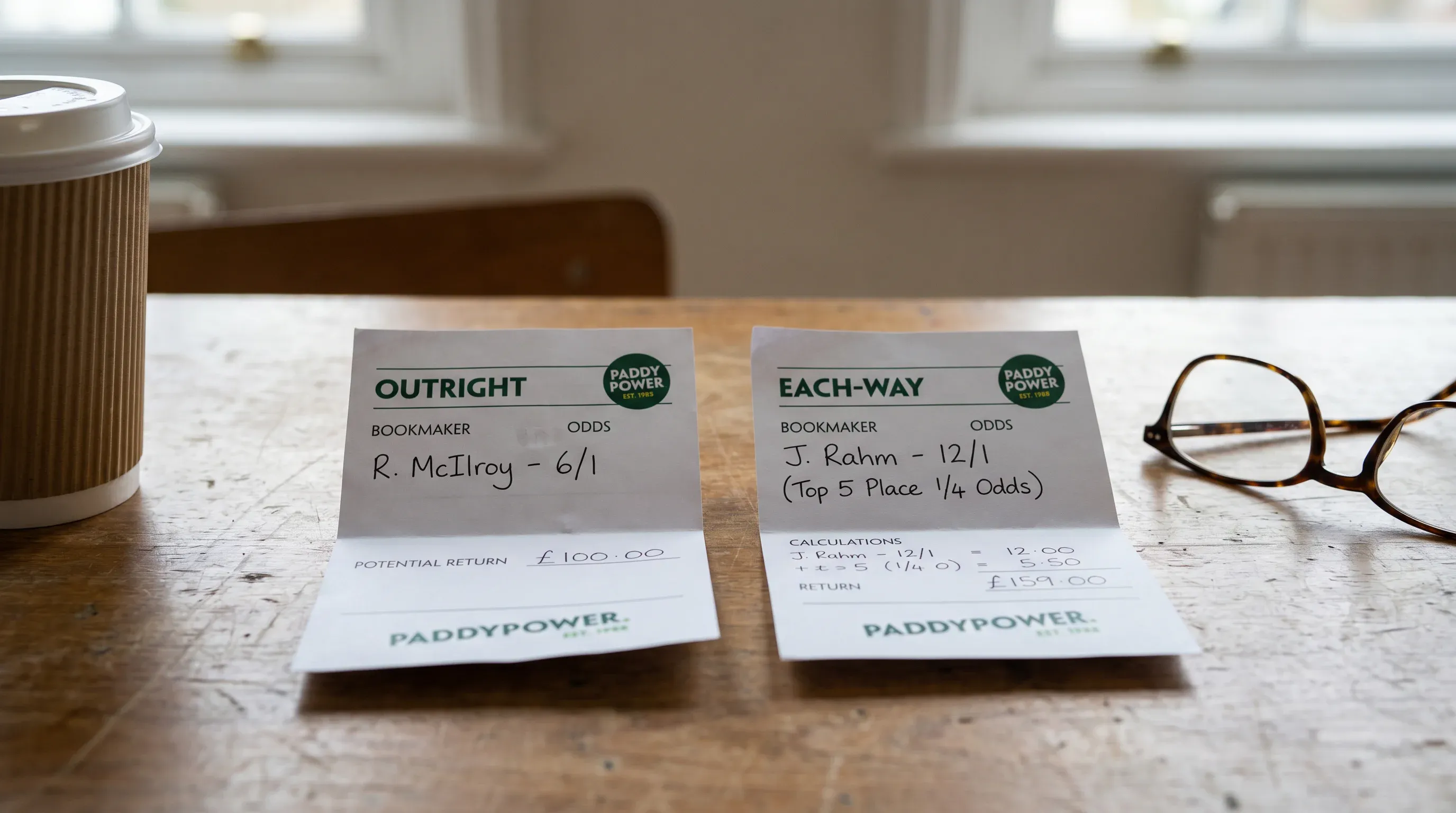
Consider a player priced at 20/1. Standard each-way terms of 1/5 the odds, 5 places means the each-way place return is 4/1. At a 1-point each-way stake (total 2 units at risk), the position returns 42 units on a win (20/1 win + 4/1 place, minus the losing win stake) and 5 units on a place finish. The outright equivalent at 1 unit at risk returns 21 units on a win and 0 on a place. The each-way bet’s advantage is the guaranteed return on a place finish; the outright’s advantage is requiring only half the capital for a comparable win position.
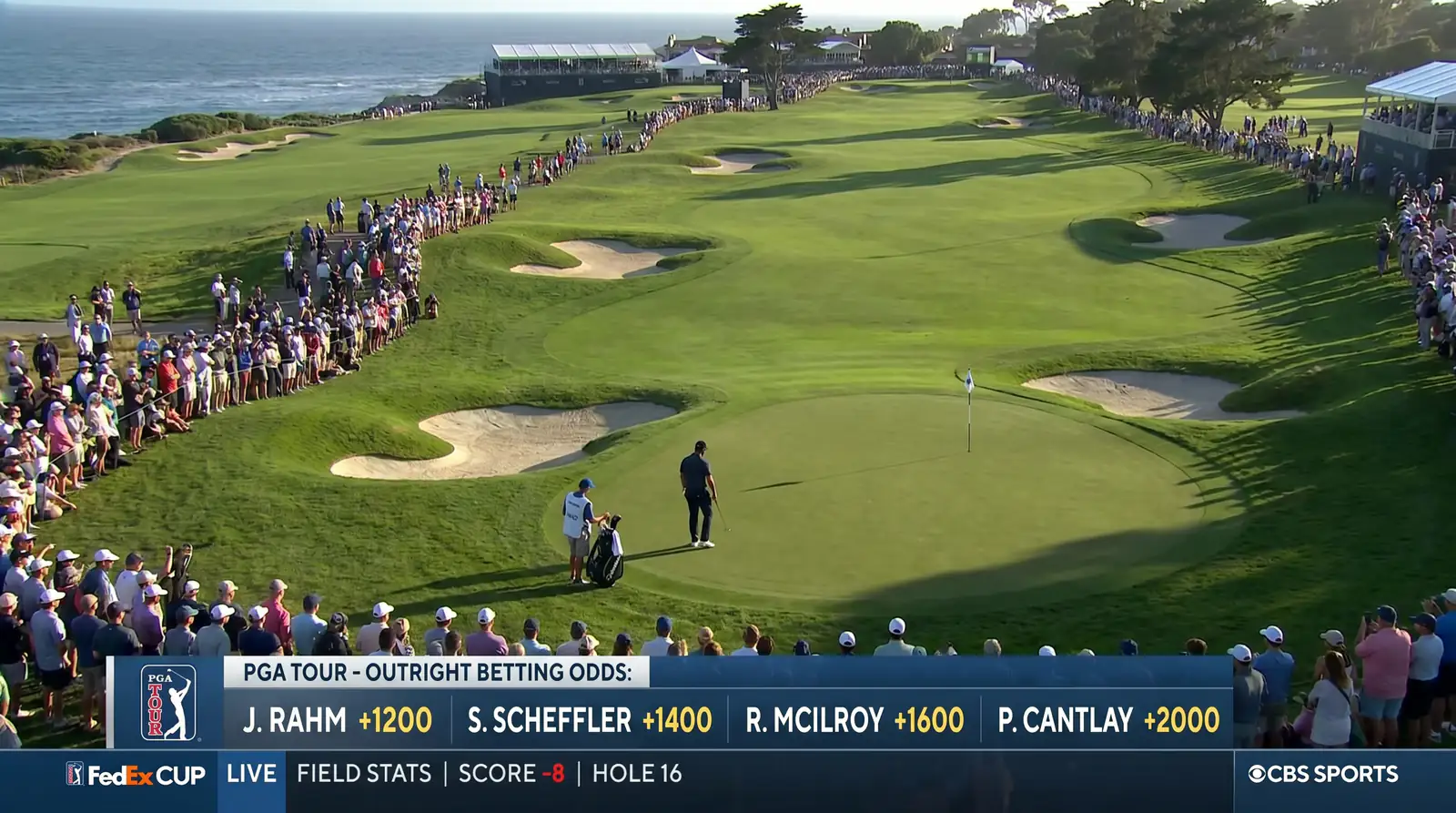
Now increase the price to 60/1 with enhanced terms available: 1/4 the odds, 8 places (a common Coral or BoyleSports offer for Major tournaments). The each-way place return becomes 15/1. At 1 unit each-way, the position returns 61 units on a win and 16 units on a top-8 finish. The expected value calculation now heavily favours each-way because the probability of a top-8 finish for a 60/1 player is meaningfully higher than the probability of an outright win, and the place return at 15/1 is substantial. At this price point, outright betting without each-way cover is almost never the right choice.
The price range where outright becomes competitive with each-way: approximately 8/1 to 18/1, in markets with standard 1/5 terms and 5 places. Below 8/1, the enhanced each-way terms at bookmakers with 7-8 place offers make each-way dominant. Above 18/1, the place value of each-way increases sufficiently that outright becomes increasingly difficult to justify. Between 8/1 and 18/1, the outright structure reduces your capital commitment while the each-way place return is modest enough that forgoing it isn’t costly. This is where outright betting belongs in a systematic portfolio—not as a general preference, but as a targeted structure for a specific price range.
Selection Criteria for Outright Golf Betting: What Changes Without Place Cover
When you remove the each-way safety net, the player profile you’re targeting changes. In an each-way system, you’re looking for players who can contend—top-10 finishes compound the bank even without a win. In outright betting, you’re specifically looking for players with a realistic chance of winning, and that requires a different analytical filter.
Tournament winners on the PGA Tour and DP World Tour consistently share three performance characteristics in the weeks before their victory: elite SG:APP in the rolling 12-24 round window, above-average SG:OTT specifically at the venue type (aerial distance courses vs. accuracy-premium courses), and consistency metrics that don’t show a recent scoring regression. That third point is subtle but important: players who are “due a win” based on consistent top-10 form often underperform outright expectations because their consistency, while valuable for each-way systems, doesn’t translate into the peak performance variance required to win a 156-player field.
Outright winners tend to be players who have shown at least one recent “spike” performance—a round in the low 60s, or a tournament performance that was 4-6 strokes better than their average—within the prior eight weeks. This spike performance indicates that the player’s current skill level is capable of the single-week peak required to win. A player whose SG:APP is consistently excellent but whose scoring fluctuates in a narrow band rarely produces the outright winner performance. The compression is the tell.
Staking for Outright Golf Bets: Sizing Without the Each-Way Buffer
Staking rules for outright golf betting need to account for the binary nature of the outcome—win or lose, no in-between. This creates a different variance profile than each-way betting and requires corresponding stake adjustments to avoid the portfolio drawdown that kills long-term systems.
My baseline: outright stakes are set at 50-60% of the each-way equivalent stake for the same player. If my each-way analysis suggests 1 point each-way on a player (2 units at risk), the equivalent outright position is 0.5-0.6 units. This isn’t arbitrary—it reflects the theoretical equivalence between the outright win probability and the combined win+place probability that makes an each-way bet positive expectation. Sizing down the outright maintains portfolio-level expected value while reducing variance exposure.
The exception to the 50-60% rule is when the each-way structure is definitively disadvantaged: markets where enhanced terms are not available and the price is in the 8/1 to 16/1 range. In these cases, the each-way bet’s place return at standard 1/5 terms is insufficient to compensate for the additional capital committed. Here I’ll back outright at full 1-point stakes and treat the each-way equivalent as genuinely inferior, not simply different.

One staking mistake worth flagging specifically: do not use outright stakes to increase your win exposure on high-conviction selections without running the full variance calculation. Doubling down on a 12/1 player with 2 units outright instead of 1 unit each-way feels like conviction. What it actually represents is a significant increase in portfolio variance for a position where the each-way structure would have been measurably more efficient. Conviction is expressed through your selection process, not your stake inflection.
Golf Outright Betting: Linking to Your Broader System
Outright golf betting works best as part of a system that also includes each-way positions, not as a standalone approach. The two structures are complementary: each-way betting handles the volume of selections where the top-10 contention case is as compelling as the win case; outright betting handles the subset of selections where the win case is disproportionately strong and the place return at available terms doesn’t justify the additional capital.
The analytical process that feeds both markets should be the same—SG data, course fit, form window, each-way terms comparison—with the market selection made at the end of that process based on price and available terms. Treating outright and each-way as separate systems with separate analytical frameworks is a mistake. They’re different outputs from the same input: a well-constructed pre-tournament golf betting analysis that a systematic each-way golf betting system builds as its foundation.

Golf Outright Betting: Your Questions
Should you ever bet outright on a player priced above 50/1?
Rarely, and only with specific justification. Above 50/1, the expected win probability is low enough that the variance of an outright-only position becomes portfolio-threatening if it represents a meaningful stake. If your analysis identifies a 60/1 player as genuinely underpriced, the each-way structure with 7-8 places at 1/4 or 1/5 the odds almost always produces better expected value than an equivalent outright stake. The exception is when place terms are genuinely poor (5 places at 1/5 on a tight field) -- in that specific case, outright at a reduced stake can be justified.
What is the typical ROI difference between outright and each-way golf betting?
Long-term data suggests each-way golf betting at enhanced place terms (7+ places at 1/4 or 1/5 odds) outperforms pure outright betting by 3-5 percentage points in ROI for players priced above 25/1. This is because the place return on large fields with generous terms adds expected value that isn't captured in the outright price alone. Below 25/1, the ROI difference narrows and can reverse. The Racing Post's Steve Palmer achieved 10.81% ROI in 2025 primarily through outright and each-way positions at higher prices, demonstrating that both structures can be profitable when selection quality is high.
At what price does each-way betting become better value than outright?
In standard 1/5 odds, 5-place markets, each-way outperforms outright from a break-even perspective when a player is priced above approximately 14/1 to 18/1. At that price, the place return generates sufficient expected value to justify the additional stake unit. With enhanced terms (1/4 odds, 7-8 places), each-way becomes superior at prices as low as 10/1. Below 10/1 in standard markets, outright betting with reduced stake is often the more capital-efficient choice.
Golf Betting Guides
Golf Betting Odds Comparison UK: How Best-Price Shopping Compounds System Returns
The most underrated skill in systematic golf betting is not finding value selections—it's getting the best available price on the…
Antepost Golf Betting Strategy: How Early Prices Create Systematic Value Before the Field Is Set
The first time I backed a Major winner antepost, I got lucky. The second time, I had a system. There…
LIV Golf Betting UK: How the Breakaway Circuit Affects Established Golf Betting Systems
LIV Golf created more analytical confusion for me than any single development in golf betting over my nine years in…
Major Golf Tournaments Betting UK: How the Four Majors Demand Different Systematic Approaches
There's a mistake I made for the first several years of serious golf betting that I see repeated constantly by…
