
Golf Betting Weather Analysis: How Wind, Rain, and Tee Time Draw Affect Your System Picks
 Available in US
Weather is the variable in golf betting that most systematic bettors acknowledge as important and then treat imprecisely. They’ll note “it’s a windy week” and adjust their selections toward players with links experience, but without a structured process for quantifying what wind conditions actually do to scoring averages, tee time draw advantages, and the relative value of different player profiles. I used to do the same thing. Then I started tracking it, and the difference between intuitive weather adjustment and data-informed weather adjustment turned out to be larger than I’d expected.
How Weather Conditions Move Golf Betting Markets in Real Time
The relationship between weather forecast updates and bookmaker pricing adjustments is less direct than most bettors assume. For outright pre-tournament markets, weather forecasts published days before an event have almost no visible effect on prices—the outright market is too blunt an instrument for weather-specific adjustments at that time horizon. What weather does affect, and visibly, is the FRL market and three-ball markets published on the morning of each round.
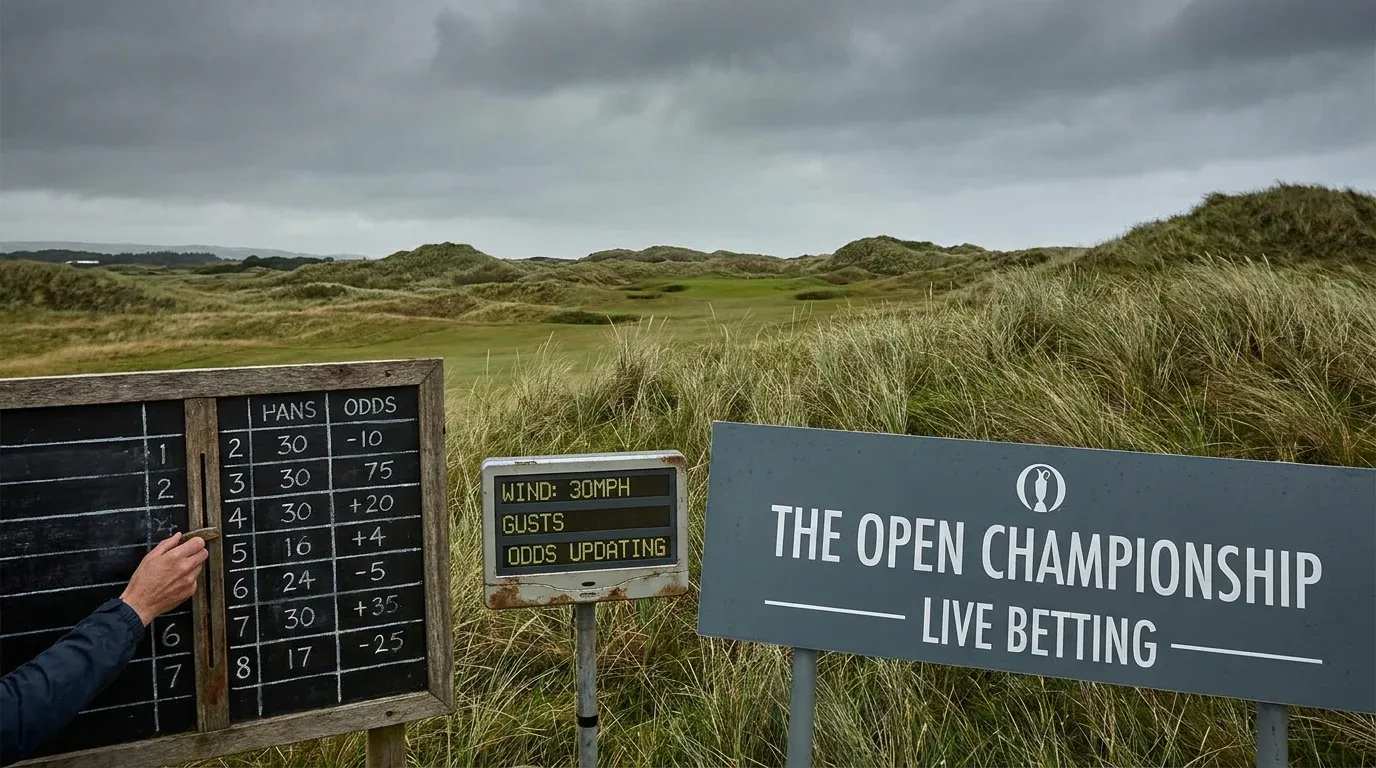
DataGolf’s co-founder Matt Courchene explained the weather integration challenge directly: “Continuous comparison of our probabilities to the betting market exposed model defects, leading to improvements: accounting for weather forecasts by tee time, adjusting player skill when leading, adding home nation effects.” The explicit acknowledgement that weather is incorporated by tee time—not by day or event—is the key insight. A single weather forecast for “30mph winds on Thursday” is analytically inadequate. The question is which tee times face which conditions, and how that intersects with which players are drawing which starting times.

The bookmaker’s intraday FRL and three-ball pricing adjustments for weather are meaningful but imperfect. When a significantly unfavourable weather window is known—say, a gusting squall expected between 10:30 and 14:00—the FRL prices for players in that window typically move, but the adjustment is often insufficient. The market averages across public bettor awareness, and most public bettors don’t have hour-by-hour wind speed forecasts when they’re placing FRL bets on Thursday morning. Bettors who do have precise tee-time weather data and who act before the market has fully adjusted can access genuine pre-round value.
The specific pre-round window for weather-informed betting: I check tee times and weather forecasts on Wednesday evening, forming my weather adjustment for Thursday’s FRL and three-ball markets. I check again on Thursday morning for overnight forecast updates. Any player who has drawn a materially better or worse weather window than their current FRL price suggests becomes a target or a fade. This is systematic, but it’s implemented in a 20-30 minute window per day—manageable within a regular weekly golf betting process.
Tee Time Draw and Weather Windows: When Groupings Create FRL Value
The tee time draw creates its most significant betting implications at links golf courses, where exposure to wind is the primary determinant of scoring difficulty. But the effect exists, at lower magnitude, at every venue type—the morning dew factor on parkland courses, the firming greens as the day progresses, and the cumulative stress on course surfaces from earlier play all create performance differences between tee time windows that the outright market ignores entirely.
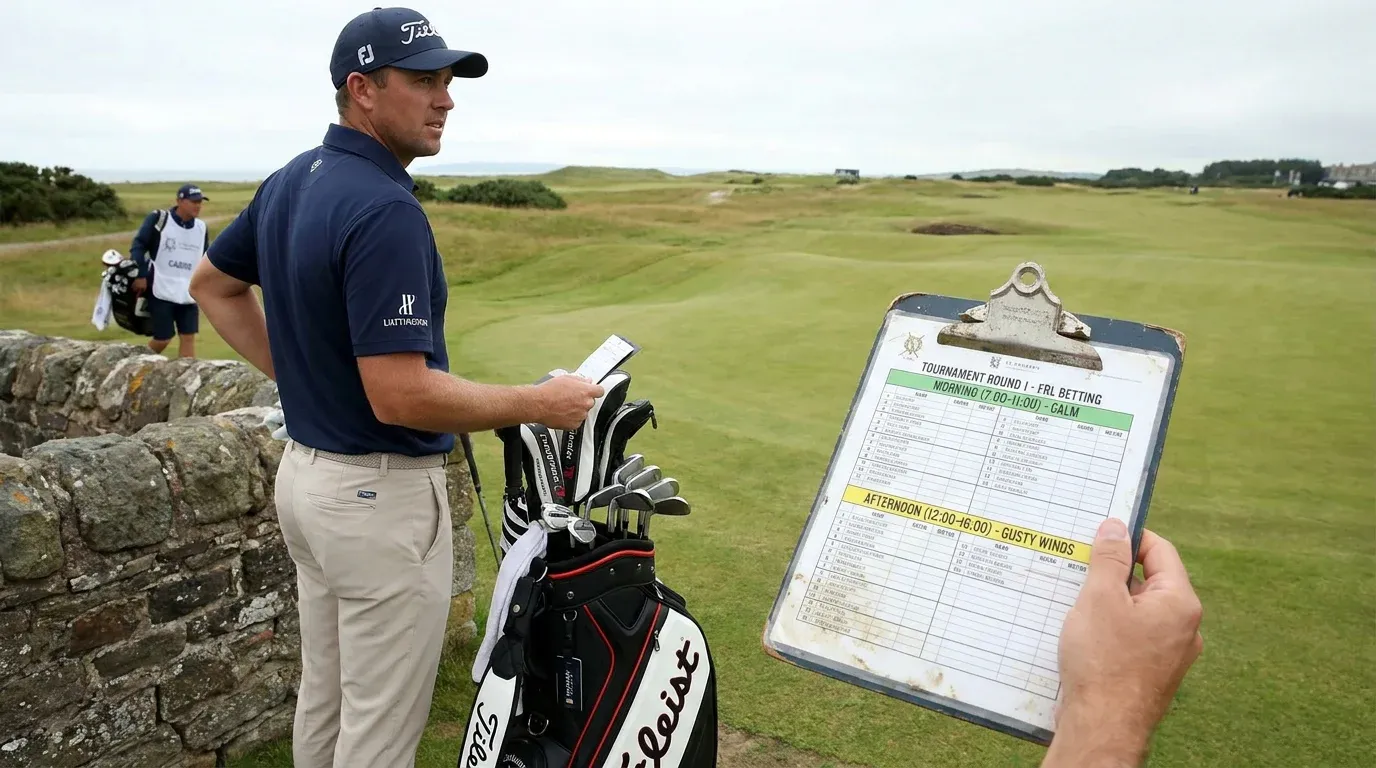
On a typical links event at a coastal DP World Tour venue, the variance in scoring average between the best and worst tee time windows on a weather-affected day can reach 1.2-1.5 strokes. That figure comes from tracking scoring distributions across multiple seasons of Scottish and Irish Open events, separating morning and afternoon draws. The figure is not constant—on calm days, the tee time advantage is minimal, typically 0.1-0.3 strokes. The value in weather-informed betting only materialises in meaningfully variable conditions.

For FRL betting specifically, the tee time interaction with weather is the most reliable systematic edge I’ve identified in the FRL market. A player with the right SG profile (elite SG:APP, above-average SG:ARG) who draws a materially better weather window than the bulk of the field is frequently underpriced in FRL markets that haven’t yet been updated for the hourly forecast. The composite signal—quality player, favourable conditions, stale FRL price—is the clearest actionable opportunity in the FRL market.
The practical resource for UK golf bettors: the golf weather aggregators that pull Met Office and ECMWF data against published tee times for major tour events. These tools typically become available for top-tier events within 72 hours of first tee time, and they provide the hourly wind speed and direction data that makes tee time weather comparison precise. Without this level of resolution, weather adjustment remains intuitive rather than systematic.
Links Golf Weather Patterns: Why The Open Championship Demands a Separate Weather Model
The Open Championship is the event where weather analysis matters most and is simultaneously the hardest to execute precisely. The reasons are structural: links weather at coastal Scottish and English venues is more variable than at any other Major venue type, the exposure to wind is maximum, and the relationship between conditions and scoring outcomes is non-linear in ways that make simple adjustments inadequate.
Historically, wind speed data from Open Championship venues shows that scoring averages on the windiest days (above 25mph sustained) are approximately 2.5-3 strokes higher than on calm days. At around 47% of UK adults who gamble, The Open generates the highest domestic betting interest of any golf event—and that public interest concentrates money on marquee names whose exposure to wind conditions is not differentiated by tee time in the public narrative.

The DataGolf model’s explicit inclusion of national home effects (“Americans perform worse at The Open”) and tee time weather adjustments represents the state of the art in systematic weather integration for golf prediction. For a UK bettor without access to DataGolf’s paid features, the practical approach is: identify the likely weather pattern for each round of The Open from reliable forecast sources starting Thursday morning, overlay against published tee times, and adjust your FRL and each-way selections toward players who are drawing the most favourable comparative conditions within the field.
One specific adjustment worth making for Open Championship weather analysis: the first round of The Open is historically where weather conditions are most often asymmetric—early draws can face gentle morning conditions while afternoon draws face deteriorating wind. This pattern is consistent enough with links coastal weather systems that it should be weighted toward first-round weather analysis rather than overall weekly weather. The subsequent rounds tend to show less tee time asymmetry as course conditions settle and weather stabilises. The weather-informed course fit analysis for links events at The Open combines this tee time weather variable with the longer-term player links profile data to produce the most precise possible pre-round assessment.
Golf Weather Betting: Questions
Do UK bookmakers adjust golf odds before the round based on weather forecasts?
Outright pre-tournament prices are rarely adjusted for weather -- the market is too forward-looking and weather too short-range to justify model changes weeks out. FRL and three-ball markets, which are published daily, do incorporate weather conditions into their pricing, but the adjustment is often imprecise because it aggregates across the whole field rather than applying hour-by-hour tee time adjustments. This is where weather-informed systematic bettors can identify under-adjusted prices on players in particularly favourable or unfavourable tee time weather windows.
How much does a 20mph wind typically affect scoring averages on a links course?
Based on historical scoring distributions from Open Championship qualifying venues and Scottish Open events, a sustained 20mph wind typically adds 0.6-1.0 strokes per player to the daily scoring average versus calm conditions on a typical links layout. Above 25mph sustained, the scoring impact increases non-linearly -- the 2.5-3 stroke daily average increase is associated with the highest wind conditions. The variance in individual scores also increases with wind speed, which affects probability distributions for FRL and three-ball markets as well as the raw scoring averages.
Is there a free resource for checking tee time draw alongside weather for golf betting?
Weather and tee time integration is available through several golf-specific tools that pull Met Office and ECMWF forecast data against published tee sheets. These tools are typically event-specific and become available within 72 hours of the first tee time for major events. The PGA Tour's official tee time release (typically 24-36 hours before round one) combined with an hourly weather API for the venue location provides all the data needed for a manual tee time weather comparison. For DP World Tour events, tee times are released on the same schedule and the Met Office provides UK venue hourly data free of charge.
Golf Betting Guides
Is Golf Betting Profitable in the UK? What the Long-Term Data Actually Shows
This is the question I get asked most. And it's the right question to ask before committing time, money, and…
Best Golf Tipsters UK: How to Evaluate a Service Before You Follow Its Picks
I have a professional reluctance to recommend tipster services, not because they're all fraudulent—some are entirely legitimate—but because the evaluation…
UK Bookmaker Account Restrictions in Golf Betting: What the Gambling Commission Data Reveals
Account restrictions are the most uncomfortable topic in systematic golf betting, and the most important one to understand clearly. I've…
First Round Leader Golf Betting: A Systematic Approach to the FRL Market in the UK
The FRL market has a reputation problem. Casual bettors treat it as a novelty—a punt on who happens to have…
