
The UK Each-Way Golf Betting System: How to Build a Consistent Edge from Place Terms
 Available in US
The first time I tracked a full season of each-way golf results against outright-only returns, the difference was not subtle. Backing the same selections each-way rather than outright improved ROI by an average of 4.2 percentage points across 140 bets — enough to turn a losing system into a marginally profitable one, and a marginally profitable one into something you could build on. That gap is not luck. It is structure. And it comes almost entirely from understanding how UK bookmakers price their place terms, and when to exploit the gaps between them.
Before we go further: if you have been treating each-way betting as simply “hedging” your win bet, you are leaving money on the table every single week of the golf season. Each-way betting at its systematic best is not a safety net — it is a distinct value proposition, and in 2025 bet365 offered 563 additional each-way places beyond standard terms across PGA Tour and DP World Tour events through their Each Way Extra feature alone. That number did not happen by accident. It happened because there is commercial competition for your each-way pound, and when bookmakers compete, informed bettors win.
This guide is not for beginners to each-way betting. It is for bettors who already know the mechanics but want to convert that knowledge into a repeatable, structured system. We will cover how place terms create asymmetric value at different price points, which UK bookmakers are offering the best conditions right now, how to time your bets to access them, and how to size stakes so that a 40/1 winner does not distort your bank calculations for the next three months.
How Each-Way Golf Bets Work: The Structural Advantage You’re Not Fully Exploiting
An each-way bet is two bets of equal stake placed simultaneously: one on the outright win, one on the player to finish within a specified number of places. The place part pays at a fraction of the win odds — typically 1/4 or 1/5 — multiplied by the number of places the bookmaker offers. Standard terms on a regular PGA Tour event are 5 places at 1/4 odds. So a £10 each-way bet on a player at 50/1 costs £20 total, and if he finishes second, you collect the place return: £10 × (50/1 × 0.25) + £10 stake returned = £135. The win bet loses. The total return on a £20 outlay is £135. Not bad for a player who did not win.
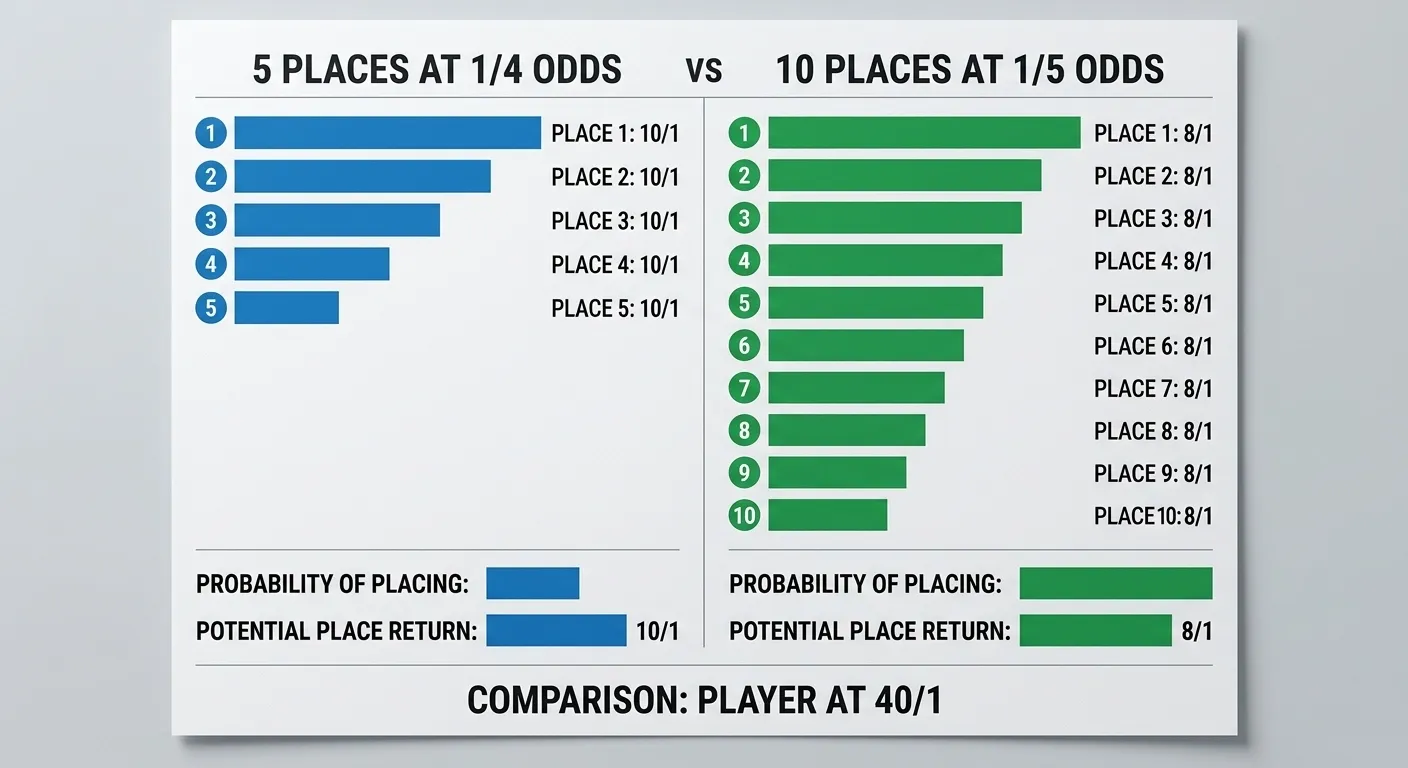
Now here is where it gets interesting. The asymmetry in an each-way bet is not fixed — it varies dramatically depending on the player’s price, the number of places offered, and the fraction applied. At short prices — say, 10/1 — the each-way place portion adds relatively little. The player at 10/1 finishing second pays 2.5/1 on the place part. That is acceptable, but not exciting. At 40/1, the same calculation yields 10/1 on the place part. At 80/1, you get 20/1 on the place part. The longer the price, the more disproportionate the each-way place bet becomes relative to the implied probability of the player reaching that position.
This is the core structural advantage: at high prices, the each-way place bet carries far more expected value than the outright bet, because the player’s probability of a top-5 finish is roughly 3-5 times higher than their probability of winning. A player at 50/1 might genuinely have a 2% chance of winning but an 8% chance of a top-5. The outright bet is priced at 2% (correctly or near enough). The place bet is priced implicitly at approximately the same level, meaning the 50/1 fraction prices the place position at roughly 0.5%. You are being offered 200/1 on something with an 8% probability. Even accounting for bookmaker margin, this is where structural edge concentrates.
Coral became the first UK bookmaker to offer 10 places on regular PGA Tour events — not just Majors — and has maintained that across the 2023–2025 seasons. That additional coverage from places 6 through 10 dramatically widens the range of finishes that generate a return, and it changes the math entirely for bettors backing players priced between 40/1 and 150/1. When a player finishes 8th in a standard 5-place event, you collect nothing on the place. In a 10-place market, that 8th place finish pays 1/5 of the win odds. At 80/1, that is 16/1. The shift from no return to 16/1 on a £10 place stake is the difference between a bad week and a productive one.
The fraction matters too, and the difference between 1/4 and 1/5 is not trivial. On a player priced at 40/1, 1/4 odds on the place pays 10/1 versus 8/1 at 1/5. That is a 25% reduction in place value. Multiply that across 100 selections over a season and it represents a substantial drag on system profitability. Part of the bookmaker selection work in any serious each-way system is identifying which operators offer 1/4 fractions on which tournaments, and routing your bets accordingly.
UK Bookmaker Place Terms in 2025-2026: Where the Extra Value Consistently Appears
I have been tracking UK bookmaker each-way place terms across PGA Tour and DP World Tour events for several seasons. The headline finding is that the gap between the best and worst available terms on any given tournament is now so wide that failing to shop around is effectively donating money to bookmakers. The variance is not marginal — it is structural, and it is consistent.
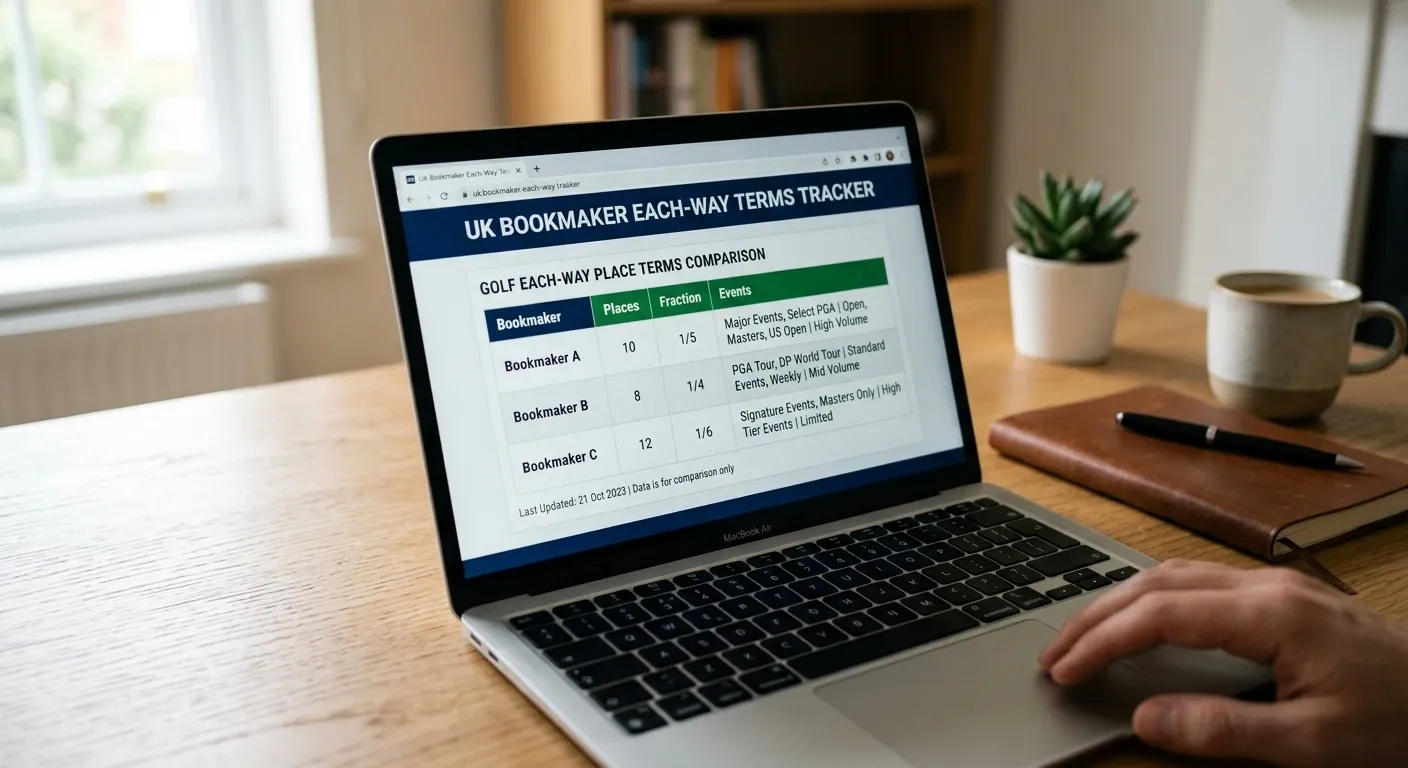
bet365 and BoyleSports are in a direct contest for the top position in 2026. Through April, they are running neck-and-neck on additional each-way places offered beyond standard terms, and both are pulling away from Sky Bet and Paddy Power by a meaningful margin. This mirrors the trend from 2025, when bet365 set a record by providing 563 additional each-way places via Each Way Extra across the full year — surpassing their own previous record of 555 in 2024. BoyleSports countered with their Pick Your Place feature, which offered selections of 6, 10, or 12 places at 1/5 odds on Major Championships, taking the top spot in that specific category for 2025.
Breaking this down by bookmaker type gives you a working map for 2026. For regular PGA Tour events, the core battle is between bet365’s Each Way Extra offers and BoyleSports’ standard enhanced terms. bet365’s approach is dynamic — the Each Way Extra offer is presented to you when placing the bet, and you must actively accept it. The enhanced terms often extend to 7, 8, or occasionally more places on standard events. BoyleSports tends to lead on clarity: their enhanced terms are advertised upfront and apply consistently across certain event categories.
Coral’s position is distinctive. Their standard each-way offer on all regular PGA Tour events is 10 places at 1/5 odds — no enhancement needed, no feature to opt into. You simply get 10 places as the base offering, every week. Since becoming the first UK bookmaker to offer 10 places on Majors back at the 2017 PGA Championship, Coral has maintained this as a consistent structural advantage for bettors who prefer simplicity over chasing dynamic offers. The trade-off is the 1/5 fraction versus 1/4, which matters more as prices lengthen. But for a bettor backing players at 25/1 to 60/1 — a sweet spot for each-way systems — Coral’s consistent 10-place offer at 1/5 often represents better expected value than 5 places at 1/4.
For Major Championships — The Open, Masters, US Open, and PGA Championship — the dynamics shift. BoyleSports’ Pick Your Place comes into its own here, allowing you to select 6, 10, or 12 places at 1/5 odds. Choosing 12 places at 1/5 on a player at 100/1 in a Major puts the place component at 20/1 across a wide finishing range. bet365’s Each Way Extra tends to be most aggressive during Major weeks too, with additional place offers that can reach 7, 8, or more. This is where having accounts with both — and checking both before placing — delivers the most consistent return differential.
Paddy Power, Sky Bet, and William Hill occupy a secondary tier in 2026 terms. They occasionally run competitive each-way promotions, particularly on The Open when commercial pressure is highest, but across a full season their consistent terms trail the top two. For a systematic bettor placing dozens of bets annually, relying on these operators as primary accounts is a structural disadvantage. They remain useful as part of a multi-account system for arbitraging specific enhanced offers, but they should not be your default for each-way golf.
The practical implication is this: before placing any each-way golf bet, you need to check at minimum bet365 and BoyleSports (and Coral for non-Major events), compare the specific terms available for that event, and route the bet to whichever offers the superior combination of places and fraction for your selection’s price point. This takes two minutes and can add 20-30% to the value of a place return over a season. For a fuller breakdown of how these bookmakers compare across account types and restriction risk, see our guide to golf each-way betting bookmakers.
Each Way Extra and Pick Your Place: How to Systematically Exploit These Features
Both bet365’s Each Way Extra and BoyleSports’ Pick Your Place are among the most valuable features in UK golf betting — and both are systematically under-exploited by the average bettor because they require an active decision at the point of placing the bet. That friction is enough to put many people off. For a structured system, it cannot be treated as optional.

Each Way Extra at bet365 works as follows: when you go to place an each-way bet, bet365’s system assesses whether enhanced terms are available for your selection and presents them at the bet slip stage. The enhancement typically adds 1-3 additional places beyond the standard offer, at the same 1/4 fraction. You then choose to accept or decline. Declining means you revert to standard terms. The decision should be mathematically driven. If the enhancement adds two places and your selection is priced at 50/1 or above, accept without hesitation — the incremental probability of finishing in positions 6 or 7 relative to the small reduction in potential value makes it almost always positive expected value. At shorter prices, around 14/1 to 25/1, the additional places matter less because the player’s probability of a deep top-10 finish is lower relative to their win probability. Run the numbers before you commit.
The trigger for rejecting an Each Way Extra offer is when the enhancement comes with modified terms — specifically, a switch from 1/4 to 1/5 odds to accommodate the extra places. This happens occasionally, and when it does, you need to calculate whether the place extension at 1/5 beats the standard offer at 1/4 for your specific selection price. On shorter prices, the fraction cut usually eliminates the advantage. On prices above 40/1, the additional places at 1/5 frequently remain the better option — but do the arithmetic rather than assuming.
BoyleSports’ Pick Your Place is simpler in concept: you choose your place count from the available options (commonly 6, 10, or 12 for Majors) and that becomes your each-way terms, all at 1/5 odds. The system gives you transparency that bet365’s dynamic feature does not — you know your terms before you commit. The strategic question is which count to select. For players priced at 50/1 to 200/1 in Major Championships, 12 places at 1/5 is almost always the correct choice. The additional places covering positions 11 and 12 do not represent a large probability increment, but the price point means even marginal probability additions carry significant expected value. For players at 20/1 to 40/1, 10 places is typically optimal — the probability of finishing 11th or 12th adds less to expected value relative to the implicit cost (which is the opportunity cost of 1/4 fraction bookmakers for some positions).
In 2025, BoyleSports led all UK bookmakers in total additional each-way places offered through Pick Your Place across Major Championships. That leadership position means Majors are where you should prioritise a BoyleSports account. For the other 40-plus weeks of the tour calendar, bet365’s Each Way Extra record of 563 additional places in 2025 tells you where the competitive edge sits on regular events.
Stake Sizing for Each-Way Golf Systems: When to Split Stakes and When Not To
One of the most common mistakes I see in golf betting is applying a flat stake to every each-way bet regardless of price. It sounds disciplined, but it is actually inconsistent — because the relationship between stake and expected variance changes dramatically as prices lengthen. A £10 each-way on a 10/1 shot and a £10 each-way on a 100/1 shot have completely different risk profiles, and treating them identically creates a bankroll that is structurally fragile.

The standard approach in a level-stakes each-way system is to fix the total each-way outlay — both sides combined — at your chosen unit size. So if your unit is £10 each-way, you are placing £5 win and £5 place, for a total of £10. This simplifies record-keeping and keeps total outlay consistent. It is the right starting point for most systematic bettors. But it does not account for the fact that a 100/1 winner at £5 win stake returns £505, which can represent 50+ units of profit in a single bet. That kind of outlier creates a volatility profile that makes system evaluation very difficult, because three 100/1 winners or their absence in a 100-bet sample can swing perceived system performance by 150 points either direction.
The alternative — which I recommend for selections priced above 66/1 — is to reduce the win stake and slightly increase the place stake. For a 100/1 selection, rather than £5 win / £5 place, consider £3 win / £7 place. The total outlay is the same £10. But the variance profile changes significantly: a win still returns generously at £3 × 100 = £300 plus stakes, while the place component is weighted more heavily toward the more probable outcome. This keeps your bank more stable across the inevitable stretches when big prices do not land.
On the other end of the price spectrum, for selections below 20/1 in an each-way system, ask yourself honestly whether the each-way structure is adding value at all. A player at 14/1 finishing 4th returns 14/1 × 0.25 = 3.5/1 on the place. That is not bad, but it is not the structural asymmetry that makes each-way golf genuinely superior to outright at longer prices. Many systematic bettors exclude selections below 16/1 from their each-way system entirely, taking those shorter-priced bets outright or simply skipping them. Over 200-bet samples, this filtering consistently improves ROI by eliminating the middle-ground bets where the each-way structure adds least.
Timing Your Each-Way Bets: Early Prices vs. Thursday Morning Markets
Golf betting markets open early — sometimes as far as 12-14 days out from a tournament — and the prices you see on a Tuesday morning compared to Thursday’s first tee are often strikingly different. Understanding how and why prices move is essential to maximising each-way value, because the place terms offered by bookmakers can change in lockstep with the market, and sometimes the early price with standard terms beats the Thursday price with enhanced terms.
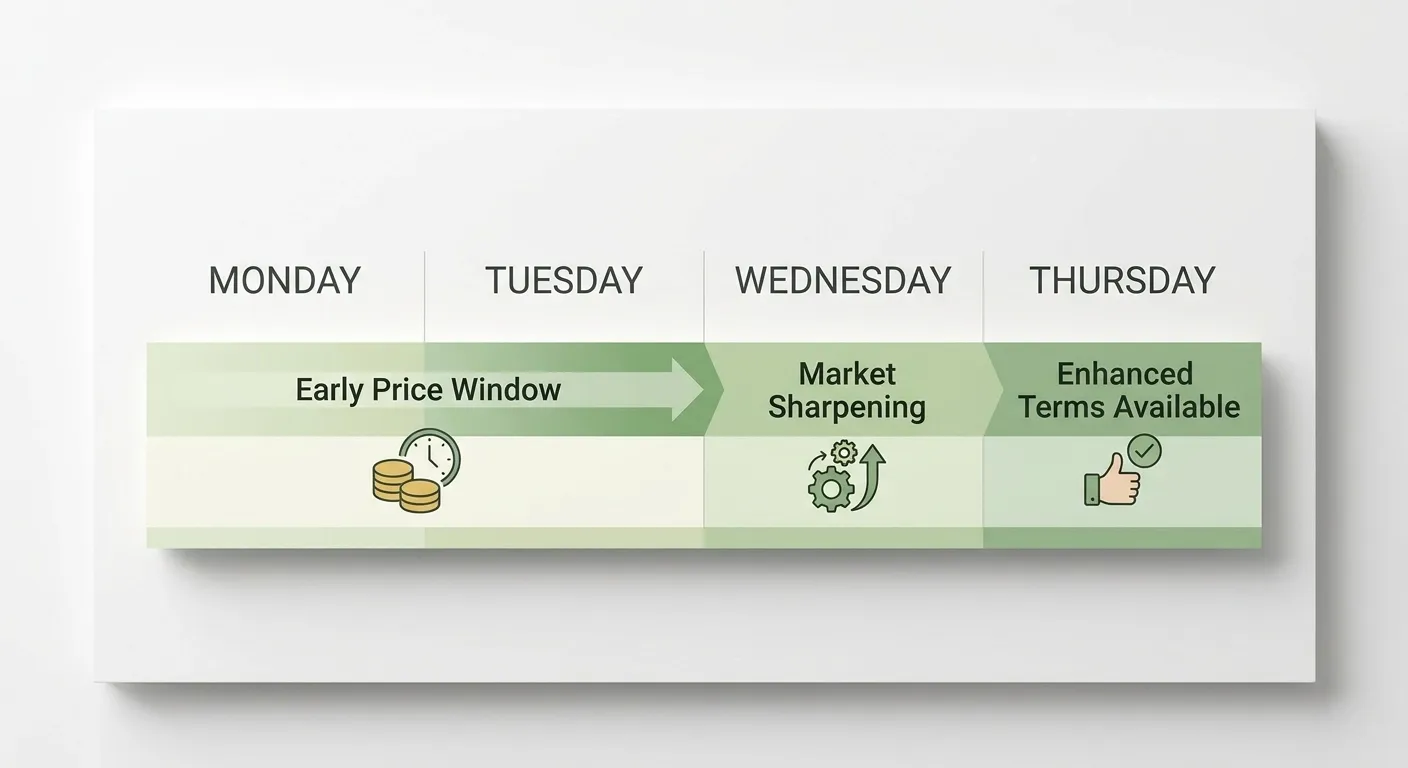
The general pattern in PGA Tour markets is this: outright prices for most players sharpen as the week progresses, because money flows in and bookmakers adjust. Field composition becomes clearer, withdrawal news emerges, and the betting public forms opinions. For most of the field — say, players at 40/1 and above — early prices tend to be longer, because bookmakers hedge against lower-confidence positions by building in more margin. The early Monday or Tuesday price on a 50/1 player may reflect genuine uncertainty on the bookmaker’s part, which means the price sometimes represents better value before the market has been “corrected” by sharper money.
The complication is place terms. Each Way Extra at bet365 is not always available from market opening — it frequently becomes available from Wednesday or Thursday as the event nears. BoyleSports’ Pick Your Place is typically available earlier in the week. So you face a genuine trade-off: take the longer early price with potentially standard terms, or wait for Thursday when enhanced terms are available but the price may have contracted. The data from tracking this over multiple seasons suggests that for players priced above 50/1, the early price advantage tends to outweigh the terms advantage in most cases — the price differential is simply larger than the incremental value from extra places. For players at 25/1 to 50/1, it is genuinely close, and the decision depends on how aggressively the specific bookmaker compresses prices as the week progresses.
There is also a course-specific wrinkle. At Major venues where the betting public piles in heavily — The Open Championship in particular, where UK bettor volume is highest — prices on well-known British and Irish players frequently compress sharply by Thursday as domestic money flows. An early each-way bet on a 33/1 player on the Monday, even at standard terms, may be structurally superior to a Thursday bet at 22/1 with enhanced terms. The win element of the each-way has simply been undercut by 33% in price, and no number of extra places recovers that.
My working rule: for selections priced above 50/1 in regular tour events, consider early prices with whoever offers the longest number. For Majors, check BoyleSports’ Pick Your Place availability before Tuesday and decide whether the terms justify waiting. For selections between 20/1 and 50/1 on regular events, the Thursday-morning market with enhanced terms is typically the better choice. This is not a rigid formula — it is a framework that should be recalibrated as you track your own bet history.
Which Tournaments Offer the Best Each-Way Value: Majors vs. Regular Tour Events
Not all tournaments are equal for each-way systems. The structural factors that make each-way betting valuable — large fields, genuine uncertainty about outcomes, competitive bookmaker terms — are not evenly distributed across the tour calendar. Some events concentrate these factors almost perfectly. Others are relative dead zones for systematic each-way value.

Golf is the third most popular sport for UK betting, with 15% of British online bettors having wagered on golf in the past 12 months, trailing only football and horse racing. Major Championship weeks account for a disproportionate share of that activity, and the commercial pressure this creates on bookmakers is the primary driver of enhanced terms. When millions of pounds are being wagered, bookmakers extend their offerings aggressively to compete for volume. This is why the Place Terms tracker data consistently shows the most generous enhanced offers clustering around Augusta, The Open, the US Open, and Wentworth (the BMW PGA).
For Major events, the enhanced terms arms race means your each-way return on a top-10 finish can be dramatically higher than at a regular event. A player at 100/1 finishing 10th at The Open with BoyleSports’ 12-place offer at 1/5 returns 20/1 on the place component. The same player finishing 10th at a regular Signature Event with standard 5-place terms returns nothing on the place. The difference between a productive each-way bet and zero return for the same finish — 10th in a 156-man field — comes purely from the terms available at the tournament.
Regular Signature Events on the PGA Tour (elevated prize-fund events with stronger fields) occupy a middle ground. Fields are smaller and higher-quality than standard events, which means the probability distribution of finishes is tighter around the top 20-30 players. This slightly reduces the each-way value for genuine outsiders — because the 80/1 player in a Signature Event is much less likely to cause an upset than in a regular 156-man field. Standard tournament weeks with deeper, more varied fields are often better hunting grounds for each-way systems targeting 50/1-plus prices.
DP World Tour events warrant specific mention. Fields are typically 120-156 players on regular weeks, and the concentration of betting volume is lower than PGA Tour events, which means bookmakers’ incentive to enhance terms is reduced. Standard terms are more common. The exception is Rolex Series events — the DP World Tour equivalent of Signature Events — where prize funds attract broader coverage and occasionally trigger enhanced term competitions similar to PGA Tour Signature Events.
Worked Example: Building an Each-Way System Around a 40/1 Shot
Let me walk through a concrete example of how the system thinking applies in practice. Suppose your pre-bet analysis — using strokes gained data, course fit assessment, and recent form — identifies a player at 40/1 for a regular 156-man PGA Tour event as a value bet. You believe the fair price is somewhere around 28/1 to 33/1, giving you a meaningful positive expected value edge.
Your unit stake for each-way bets is £20 total (£10 win / £10 place).
Standard terms at most bookmakers for this event: 5 places at 1/4. Your place return on a top-5 finish: £10 × (40/1 × 0.25) + £10 = £110. Win return: £10 × 40 + £10 = £410. Total return if winner: £520. Total outlay: £20.
Now, bet365 offers Each Way Extra: 7 places at 1/4. The extended cover means a 6th or 7th place finish — outcomes with meaningful probability at this price — now generate a return: £10 × (40/1 × 0.25) + £10 = £110. The win scenario is unchanged. The difference over 50 selections like this is significant: positions 6 and 7 collectively carry perhaps 4-5% combined probability for a 40/1 player. Over 50 bets, you might expect 2-3 of those extra-place finishes that would have returned nothing under standard terms. At £110 per return, that is £220-£330 in additional receipts — from the same selections, the same stakes, simply routed to the right bookmaker.
Steve Palmer’s 2025 results at Racing Post provide a real-world calibration point for what a disciplined golf betting system can achieve: an ROI of 10.81% from 1,376 points staked, with 13 winners including prices of 66/1, 60/1, and 40/1 on three separate occasions. That return was built on outright recommendations — adding an each-way structure with enhanced terms on the longer-priced selections would have boosted those headline numbers further. The 40/1 winners alone, at £10 place stakes with 7-place enhanced terms, would each have returned an additional £110 even without winning — coverage that outright-only approaches miss entirely.
The practical discipline: build your each-way shortlist each week, check both bet365 and BoyleSports for the specific terms available, calculate your expected return under each set of terms, and route accordingly. Do this consistently across a full season and the compounding effect on ROI is material. A system that generates 6% ROI on outright stakes can realistically become 9-11% ROI with the each-way structure and bookmaker optimisation applied systematically.
Each-Way Golf Betting: Your Questions Answered
The questions I get most often about each-way systems reflect the same confusion points that cost bettors money year after year. Here are the ones that actually matter.
The Each Way Extra feature at bet365 is worth engaging with seriously, but it is not always worth accepting. The correct approach is to calculate: additional places offered, multiplied by the estimated probability of finishing in those positions, multiplied by the place fraction, minus the stake. If that number is positive relative to the standard terms alternative, accept. This calculation takes 30 seconds once you have done it a few times, and refusing to do it is just laziness with a financial cost.
On taking maximum places available: for selections priced above 40/1, the answer is almost always yes. The Racing Post’s each-way strategy analysis makes this point explicitly — when you are backing outsiders at high prices, taking only five places is rarely the right decision, and the competitive pressure during Majors in particular makes maximum-place offers available. The question is not “should I take more places” but “which bookmaker is offering the most places at the least-bad fraction for this specific selection.”
The 1/4 versus 1/5 fraction question matters more than most bettors appreciate. On a 40/1 selection with 5 places: 1/4 odds pays £110 on the place. 1/5 odds pays £90 on the place. That is a 22% reduction per returning bet. Across 100 place returns in a season, the fraction choice accounts for 22 units of difference. That is not rounding error — it is the difference between a profitable system and a breakeven one at the margins.
Frequently Asked Questions
How does Each Way Extra at bet365 work and is it always worth taking?
Each Way Extra presents enhanced place terms at the bet slip stage. It adds 1-3 places beyond standard, usually at the same 1/4 fraction. Accept when backing players priced above 40/1 without modified fractions. Reject if the enhancement switches from 1/4 to 1/5 and your selection is priced below 30/1 - run the maths first.
Should you always take the maximum number of places available for outsider golf bets?
Yes, for selections priced 40/1 and above. The incremental probability of finishing in positions 6-12 relative to positions 1-5 is meaningful at those price points, and the place fraction applied makes each additional covered position carry genuine expected value. The exception is when maximum places come with a significantly worse fraction.
What is the difference between 1/4 odds and 1/5 odds on each-way golf bets - and does it matter?
On a 40/1 selection, 1/4 odds pays 10/1 on the place versus 8/1 at 1/5 - a 25% reduction. Across a full season of each-way bets, this fraction difference can account for 15-25 units of profit or loss. It is one of the most impactful and most overlooked variables in each-way system design.
How do Coral's 10-place terms compare to standard each-way offers for golf outsiders?
Coral's standard 10-place offer at 1/5 odds on all regular PGA Tour events consistently outperforms 5-place offers at 1/4 for selections priced between 30/1 and 80/1. The additional five places covered more than compensate for the fraction reduction at those price points. Above 80/1, the 1/4 fraction bookmakers become more competitive again.
Golf Betting Guides
Golf Betting Market Types UK: Which Markets Suit Systematic Bettors and Which Are Traps
The first systematic mistake I see bettors make when approaching golf is treating every market type with the same analytical…
First Round Leader Golf Betting: A Systematic Approach to the FRL Market in the UK
The FRL market has a reputation problem. Casual bettors treat it as a novelty—a punt on who happens to have…
UK Golf Betting Regulations 2025: What the New Gambling Commission Rules Mean for Systematic Bettors
The regulatory environment for UK sports betting changed more significantly in 2025 than in any year since the Gambling Act…
DP World Tour Betting Strategy: How the European Circuit Differs from PGA Tour Systems
The first time I tried to apply my PGA Tour betting framework directly to a DP World Tour event, the…
